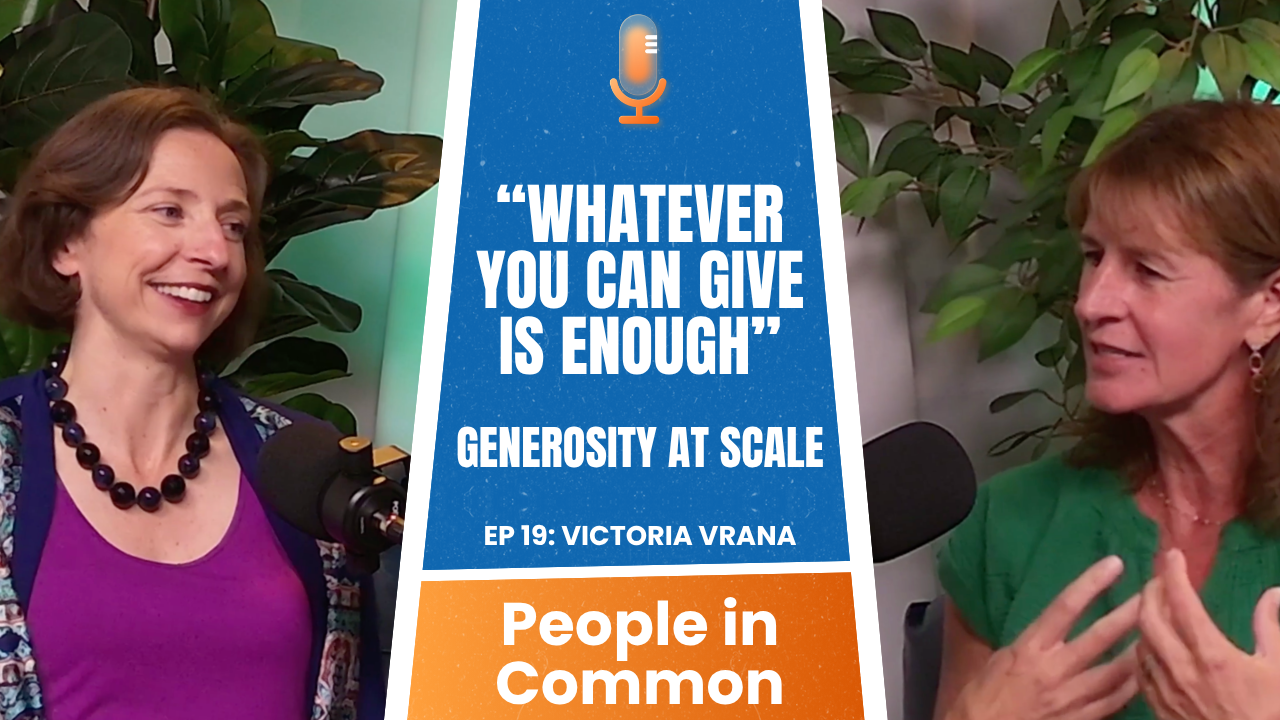
Victoria Vrana - Episode 19 People in Common Transcript Recorded September 22, 2026 INTRO (static open) Welcome to People in Common. I'm Jama Adams. This is a podcast where we talk to leaders about connecting their personal stories to what's happening in this moment. What are we supposed to do? How do we translate values into action? How can we be People in Common? Jama Adams (03:28) Victoria, welcome to People in Common. Victoria Vrana (03:32) Thank you so much. It is amazing to be here. This is such a welcoming space. It's just the perfect place to have this conversation. Jama Adams (03:40) We're in a new cozy studio now and we're just we've got blankets, we've got pillows, we're and we're mic'd. It's all very Victoria Vrana (03:48) Very real. It's very real. Absolutely. Jama Adams (03:50) Welcome. Welcome. There okay, there are so many reasons that I wanted to talk to you. One of them is because you are an expert on giving. And I wanted to start with giving is declining. And you have said that is directly related to democracy and civic participation, which you and I care a lot about. So t yeah, tell me what you've been thinking about this and what we do. Victoria Vrana (04:19) Yeah. Yeah. I it's a great place to start. So, you know, the what the research is showing us and what the numbers are showing us is that participation in giving is declining. So since about 2008. So for we have this amazing tradition of generosity in America. And we should talk about that some too. Good job, folks. Just amazing kind of, you know, centuries really of charity and giving and coming together. And the level of giving stayed the same for many decades. Like over 50% of American households were giving to nonprofits every single year. But around 2008, there started to be this slow decline. And you know, researchers kind of look at that. Due to economic forces, due to disposable income. Exactly. At that time. Exactly. And people have to make choices about what they're doing. And so, you know, the amount of money that's going to nonprofits is like increased. So we call it dollars up, donors down. So you just have dollars up, dollars up, donors down. Jama Adams (05:20) I feel like we need a shirt. Victoria Vrana (05:23) But it's not exactly what we want, right? Jama Adams (05:25) No, and i and is it related directly to the fact that there's more billionaires? Yep. Victoria Vrana (05:29) It well, I mean one would think, right? And so you do have more people with means who are giving larger and larger gifts. Yay. Yay! That's Jama Adams (05:39) Okay. Victoria Vrana (05:39) a fantastic thing. Thank you. That's a really good thing. Yes. The problem with that though, and you're getting at it when you talk about democracy and kind of civic participation. So when you have fewer donors, that means you have fewer causes that are supported. Right. So right now one of the beauties of the landscape of the sector in the US is that everybody gives to what they want to give to. Everybody gives to what they care about. So it's this incredible tapestry of causes and non profits and organizations. And when you have fewer people giving, by necessity it's kind of fewer causes. And then there are fewer organizations that are getting funds. And what we see is that the small local grassroots organizations get missed, right? They're hard to see by some of the larger donors. And so Jama Adams (06:26) Yeah, like i right. You're looking to give a hundred million dollars. That's not how would the local community access this? Victoria Vrana (06:34) Exactly, in the community media program that's training young people in a small town to engage in media and communications, right? And so they might get overlooked by the big donor. And so you're losing that kind of connection between donors and between the smaller organizations. You also when you have fewer donors, so imagine you're a nonprofit, right? And you've got three big donors who are giving you $10 million dollars each. Awesome, right? You've got thirty million dollars. But if you have many, many, many, many donors giving you that kind of funding, you have this broader base of support. And every single one of those donors can be a champion for you. They could be a volunteer for you. Jama Adams (07:15) They’re out on the streets. Victoria Vrana (07:16) Telling it for you. They're sharing the word. They're bringing more people in. They're advocating. Like if you need people to sign a petition, you've got thousands of people versus three. Yeah. And so you're kind of losing this richness in our sector. And so that's a challenge. And then The connection with democracy is also really important. So There's research from a couple of years ago that shows that people who give are 10% more likely to vote. To go to the polls. Jama Adams (07:45) If you're a donor, you just are also voting. Victoria Vrana (07:48) Yeah, you're connected, right? Jama Adams Makes sense. Victoria Vrana (07:49) You're engaged, you're connected, you're in there and you know what's going on and you're closer to your community and you're closer to some of the issues. And if you volunteer, you're twelve percent more likely to go to the polls. So There's just this inextricable link between democracy and giving and generosity. And so we need to strengthen both sides of those things right now. Yeah. Jama Adams (08:13) Yes. I mean again, okay, so that makes sense. It makes sense that you're more involved. You're going to be doing all the ways to be involved. It also I mean, is it as simple as I care, you know whatever my passion, whatever I give to, whatever I volunteer for, do I also vote? Like. Is part of the reason that is true is because I'm voting based on the issue that I care about. So I'm an environmentalist or I'm, you know, women's reproductive rights is my jam. Yeah. And so I'm going to go to the polls and do that too. Victoria Vrana (08:48) Right. Is that at times, yeah. And there's a connection. So, like if you're engaged in kind of education in your community, you're you know more about what's happening and what's happening with that cause. But it's also just a general kind of correlation that if you're engaged, you're going to be engaged in democracy as well. You're going to take that extra step to go vote, yeah, to get the ballot in, to do those things. And so there is this really important link between the two. Jama Adams (09:16) Yeah. So I personally know a lot about Victoria's deep democracy engagement because I, well, let's get into that more, but tell me where does that come from for you personally? Like where did that start? Why is that so important to you? Victoria Vrana (09:33) It's a good question. I mean, I think for me the two things are linked too, right? Same. So when I go you know, I look back and I think what really kind of prompted me to get in this space and to work in this space and volunteer in this space I try to have other hobbies, but it's tough. And you do. Jama Adams (09:55) You're cool in many aspects, but let's be real. There's a little bit a lot of time. Victoria Vrana (10:00) time in the social change space, you know. And you're grateful. Well, so I think it really for like for most of us, it really starts with my family. You know? My father was in the military. Yeah. And so service is just like core, right? Like that's what you do as a profession. You serve. Yeah. Not like you go make a ton of money. You serve. Right. Like that's what you do. So he served his country. My mom was a nurse. Okay. And for the last part of her career for like twenty five years, yeah, it's a total service caring kind of profession. But she was a public health nurse. Wow. Yeah. Yeah. Actually here in California in Solano County. No way. Jama Adams (10:40) Hey. Yeah. And what did she what was her daily life? Was she Victoria Vrana (10:42) So a big part of her job was to go visit moms with new babies. And so she drove all over. I know, right? Right? And I don't know if that's a common program in public health programs around the country. I worry it should be. I worry that it may not be. It seems like it should be. It was incredibly effective when my mom did it. But she traveled all over this county and you know Solano County, there's bigger places and there's tiny places. A lot of she Exactly. Yeah. She's like out in the middle of nowhere. And my mom would always go beyond her mission, right? Like she wouldn't just check on the baby and be like, check. Jama Adams (11:20) Shocker. If you’ve met Victoria, then that is not a shock. Victoria Vrana (11:23) Right, right, exactly. She wasn't like, here's the mom, here's the baby, all's good. Check go. Jama Adams (11:27) Check. Victoria Vrana (11:27) Yeah, yeah. She would find a reason to look in the fridge to see kind of what was going on. Yeah. She would talk to the other kids in the house. She always, in her trunk, she told me she always had three things: she had clothes, she had books, and she had food. And so she was always, you know, she ended up helping people find new homes, helping people find jobs, helping people get transportation to the doctor for the middle child who needed to get their vaccines, right? Right. Like so, you know, and I heard these stories, little stories. She didn't talk about it a lot. She actually talks about it a lot now, in her kind of older age. I'm hearing all these stories I never heard. But you know, you feel it when your parents are kind of engaged in that. So anyway, I think you know, so a lot of that came from like what my parents did every day. And then I had these two big sisters. So I was the third of three girls, and they went off to college and they came home with a lot to tell me, right? And so this is kind of the political activism part. So my parents grounded me in generosity and service and caring for people. My sisters went to college and were like, human rights, you know, prisoners of conscience, Nelson Mandela, you need to know about these things, 10-year-old, and you need to get on it, you know, as only bossy big sisters can. Jama Adams (12:49) That's right. Victoria Vrana (12:50) You know, so they really introduced me to like action and taking action and social action. So my big sister about Jama Adams (13:00) How did your parents feel about it. Victoria Vrana (13:01) this. Well they didn't notice for a while right Jama Adams (13:04) No they were surreptitiously just like, All right, little sister, we're going to train you in the act. Victoria Vrana (13:10) Exactly. You know, they're just kind of telling me what they're telling me and my parents didn't notice. But I'll tell you a story about when my mom noticed. So my oldest sister comes home. She was at Berkeley at the time, and it was the time of like protesting against apartheid and like all of this g Jama Adams (13:27) Yeah. Victoria Vrana (13:28) Global political action, right? Wow. And so my sister comes home, she tells me all about Amnesty International, right? She tells me about human rights abuses, which is horrifying as like a twelve year old. And then she talks to me all about this organization, Amnesty, you got the candle, you got the barbed wire. And you can just write these letters and help people get out of prison. Right? It was just like this powerful concept. Jama Adams (13:54) As a twelve year old, you're like, I can pick up a pen. Victoria Vrana (13:57) It's super powerful. And you become a member. And again, this is a great example. Amnesty has thousands and thousands and thousands of members and needs them. Yeah. Right? If Amnesty has just like five big donors, who's going to write all the letters? You know? Jama Adams (14:10) Right. Right. Victoria Vrana (14:12) So it was back in the day you became a member of Amnesty and they sent you stuff in the mail every month, which was like so cool as a twelve year old. And so I'd get these packets and I'd write these letters and I'd do all these things. So one day my packet comes and it says start an Amnesty chapter in your town. Jama Adams (14:27) right. Victoria Vrana (14:28) It gave you a flyer and it gave you points on how to do that, how to organize. And so I go to the library and I photocopy the flyer and I put my home address Wednesday, 7 p.m., you know, whatever. And I stick it up in the library and I stick it up around town. I'm like twelve years old, right? Stop it! I'm going to start this Amnesty chapter, and so you know, I'm terrified and like but sure. I've got my little materials, so I'm all ready to Jama Adams (14:53) Did your parents know about this part? Victoria Vrana (14:55) No, so I didn't tell at all. And my sisters are back at college, right? They're gone, they're doing their thing. And Jama Adams (15:01) You've been radicalized. You are like starting a chapter. Victoria Vrana (15:05) Exactly. And these people knock on the door, my mom answers the door, and they're grown-ups. Yeah. And they're like, We're here for the Amnesty meeting. She's like, No, you're not Jama Adams (15:14) She’s like, the what now? Yeah. Stop it. Victoria Vrana (15:18) And so she redirected my energy and I created like a chapter at my high school a couple years later. You know? So yeah. Anyway, so my parents, you know It did start early. It did. But it's all about my family, right? And that is the big thing about getting engaged. Is the biggest reason that people give to a non profit is because friend or family asked them. That's right. Yeah. W again another reason Jama Adams (15:44) So That's right. Like everything in life. Why do you do something? Because people around you are like letting you know that's the thing to do. Victoria Vrana (15:53) Exactly. And that's that trust bridge too. Because, you know, if you ask me to get involved in a cause or a activity on a Sunday morning. Right. And I will do where I trust you. You know, and so I'm going to Jama Adams (16:04) You but yes. Victoria Vrana (16:08) I'm not going to go to the lengths of the world to validate the organization or whatever. Like you know them, you told me it was a good thing to do, I'm going to do it. Yeah. And so that's really powerful. Jama Adams (16:19) It's incredibly powerful. And now okay, so what you now you are CEO of the biggest version of that. Well, right, right. I want to we'll get some in the in between there. That's fine. But Now you are the ultimate arbiter of trust based giving, right? There are what, ten million organizations that want to be part of the GlobalGiving platform. Right. And six thousand, you know, two hundred some right are on there. So when I go onto GlobalGiving.org, I know that those six thousands have been looked at by you and your team and I can you know the ultimate trust bridge. Victoria Vrana (16:57) Right. That's exactly right. So that trust and that connection between donors and organizations is one of the most important things to kind of completing that generosity loop. And there's lots of things that can get in the way with it, right? Like lots of people you generosity is like this human trait. It's an innate quality. I really deeply believe that. But you know, we all have good intentions and you hear about something and you think, I'm going to give, and then like five hundred billion things get in the way. Sure. Hard to do, you forget, you know, you don't have your credit card, you can't write a check, whatever. There's friction in the system. Yeah. And so part of that friction can also be about trust. Because if you don't know an organization, right, right, in the cause that you care about. Right. Let's say there's a des that there's a disaster far away and you care very much. Jama Adams (17:50) Yeah. We're all - our hearts are on the floor. We're watching the you know, or we're watching on our phone. Victoria Vrana (17:56) Exactly. But you don't know how to connect and you can't you don't know who to give to. And so GlobalGiving Jama Adams (18:03) But don't worry because Victoria does. Victoria Vrana (18:05) I can tell you how. That's exactly right. You know, like at GlobalGiving we really believe in local organizations. Yes. And that people in communities have some of the best solutions to their challenges. Jama Adams (18:17) Which makes sense, right? The people closest to the problem probably know the most about it and know what's actually needed. Victoria Vrana (18:24) Exactly. Exactly. And so, like, how do you support those organizations, especially in a time of crisis? Jama Adams (18:32) Right. When the phone lines are down and nobody's you know, there's not the kind of luxury of time and you know Victoria Vrana (18:38) Yeah. And those organizations, those local organizations, they're like the first responders, right? They're there already. Literally. They're there. And they'll be there like long after the cameras leave. You know, they're the ones who are in there for the rebuilding, for the resilience, for the reconstruction. And so we really kind of preference and look for those organizations. And because we have all these relationships already with the organizations you're talking about, we have trusted partnerships. We've done all the due diligence and compliance and all the check. Exactly. Jama Adams (19:10) Finances figured out, you know, you've rooted out kind of yeah, all Victoria Vrana (19:15) Yeah. Jama Adams (19:15) the folks who are doing the wrong things with the money. Victoria Vrana (19:18) Right, right. And w so we know that our partners are doing incredible work and that they're safe to give to even if they're very far away and they're not in your backyard. You know, they feel like they're in your backyard. Yeah. And then we really help make connections and long term relationships between those organizations. So they send like Exactly. Jama Adams (19:38) The nonprofit helping nonprofit vision is really to Yeah, say more about the connection Victoria Vrana (19:44) Yeah, yeah. So GlobalGiving is a nonprofit. We always have been. And so, you know, we're more than just a kind of transaction platform. We have a mission to support those donors and to help them build that relationship, to create communities of donors, and to really help those organizations build up their digital resilience. You know, to figure out how to be online, no matter where in the hundred and seventy-five countries. We work in you are right. We're all over the place. And so people have very different capacity for working online. And so we're helping strengthening those organizations. And part of the connection is that our organizations make quarterly reports online to their donors, and so they're really telling stories and like sharing what's happening with you know, even a $20 gift that's made in January, you'll hear about it all year long and how it really enables like the organization to do great work. Jama Adams (20:49) Yeah, yeah. How do you I mean, what's the hardest part about that? Right? Like you say, there's such I mean, of the six thousand plus organizations, there's a huge range of how big they are, how savvy, digitally savvy, how much like how their internet connection, how strong you what I've like there's such a big range. What's the hardest part about connecting some of these groups? Victoria Vrana (21:14) That's a great question. I think part of what's difficult is the matchmaking, you know, and really helping Jama Adams (21:22) 'Cause you're doing a lot of things at once. You're walking chewing gum, introducing people. Victoria Vrana (21:27) Exactly. And like how do you when a donor comes to our site, how do you help them make that perfect connection? There are a lot of new digital tools that are going to help us do that better in the future. So we're looking hard at like, you know, what are some of the beneficial uses of AI that can create relationship and not eliminate it? And so kind of like making those perfect fits and then making those connections last even longer. Yeah. That's one of our big aims in the next year. Jama Adams (21:59) Yeah. Right. See more about this partnership that you're is it Kindora is one of the partners, right? Victoria Vrana (22:05) No not yet. Not yet. Not yet. I Jama Adams (22:07) Justin Steele was just on the podcast. Victoria Vrana (22:09) saw that. And I saw Justin do a demo of Kindora. It is amazing. Jama Adams (22:14) It's it but like it's one of those tools that you're talking about and the trust ba like the that's the thing we really spent a lot of time talking about is that trust piece. How Victoria Vrana (22:23) Exactly. Jama Adams (22:24) d you know, like how do you leverage the best of these tools? 'Cause that's what they are. But like all tools, Victoria Vrana (22:29) Yeah. Jama Adams (22:31) they can be used for all kinds of purposes. So how do you right? Like how do you take the best of Salesforce is a partner, right? In the getting the agentic AI to do the The easy parts? Yeah. Like the parts that you know, where so that the humans can focus on some is that right? Victoria Vrana (22:49) That's exactly how we think about it. So GlobalGiving was incredibly fortunate this year to get selected to be part of the Salesforce accelerator. I know. It was like 800 organizations. We felt incredibly lucky to get to be a part of this. So they're giving their partners technology, but they're also it's this very well designed cohort model. So you're meeting other organizations. Kind of like Jama Adams (23:18) global giving, right? It's not just, hey, each of you we're going to talk to you separately. The idea is Victoria Vrana (23:24) We're learning together. Right. And so we get to learn from other organizations that are doing different things with agentic AI, but they're related. Yeah. And we get to see where they're struggling and how they figure things out. So we've got this cohort learning model. And I know these relationships are going to last way beyond the accelerator, right? Which is great because there's so many other things we can do together. And so it's technology, it's a cohort model, it's people. So we have amazing people from Salesforce working with us. yeah. Jama Adams (23:55) They love to. Especially when you work for a big old company, right? Who doesn't want to be helping GlobalGiving do better matchmaking and get this out to more people? Like Victoria Vrana (24:07) Right. Right. For Salesforce it has many benefits in the company and engaging employees is definitely one of them. Yeah. But what I like about it is this our Salesforce folks are building our skills. Just like I was saying about GlobalGiving, like it's helping organizations build their capacity. So they're not do they're not building the thing. Yeah. They're coaching us, right? Yeah. And so we're gaining all these skills that again it'll last longer. Jama Adams (24:33) It’s like here’s this beautiful thing, and then it's like nobody knows how to use it and it never gets used again. Victoria Vrana (24:38) Exactly. Jama Adams (24:39) Not that we've ever seen that before. Victoria Vrana (24:40) That's right, and the Salesforce Accelerator people are so thoughtful about that and they're analyzing each cohort to say, okay, what worked, what didn't, what barriers got in the way. So they're very realistic about it. It's not like we're going to do all these amazing things. Like we're going to help you make this fit. Right. So a really well designed program. And that but what we are using it for is to create a pilot of something we're calling Matchforce, which is a curation tool. So it's exactly what we're talking about that matchmaking. Because for GlobalGiving, and so you know, at GlobalGiving, about 40% of what happens with our donor and nonprofit connections happens online. Okay. So it's everyday donors coming to the website and making gifts of all global org. Jama Adams (25:34) GlobalGiving.org. Victoria Vrana (25:35) That's exactly right. It's very easy. But another large part of what we do is more behind the scenes. Jama Adams (25:38) Yeah. Victoria Vrana (25:38) So we're supporting companies and doing global grant making. Right. And we're supporting high capacity donors. Jama Adams (25:45) Okay, so big companies and people with lots of money come directly to GlobalGiving and say, like, help me navigate, help me find these best places. Here are my values, here are my company values, this is what our employees care about, here's the survey. Help us find the perfect match. Victoria Vrana (26:04) And we get All kinds of requests. You know, so the others I Jama Adams (26:07) Weirdest one, yeah. Victoria Vrana (26:08) don't know about weird. They're just they're all very specific. And again, they show that incredible diversity of what people care about. Right. We got one the other day that said we'd love a list of five organizations in South Korea that support single parents. Wow. So it was like okay. We Jama Adams (26:23) Their filter Victoria Vrana (26:24) were specific. We were working with a company. Did you have five? We did have five. Stop. We totally said five. Yeah. Yeah. And when we'd Don't we've got other data sets to pull from and part to a network to say, Jama Adams (26:38) And networks. I was going to say you call that out to Victoria Vrana (26:42) Okay, you know, and we can go to our organizations in South Korea that might not be working with single parents, but maybe they work with families or children. Or you know, and we say do you Exactly, exactly. So you can kind of triangulate through partnership. Okay. But then, you know, we had a company the other day that wanted a long list. So, you know, they wanted they were in thirty different countries, organizations that dealt with play and or youth and or both that were of a certain size, and run by a certain type of leader, you know, so very specific again, but also broad because you're touching a lot of different countries and a lot of different aspects. Jama Adams (27:25) But this is what AI is best at. Victoria Vrana (27:28) Exactly. Jama Adams (27:29) Right? Like exactly I mean, obviously you guys have that expertise and it's not it's only good at it because of the data sets and the expertise that you guys have built. But that's literally one of the best use cases, right? Is like, I need you know, it has to be this, but and you're so close, but actually it needs to be this, this and this, or nope, come try again. Victoria Vrana (27:49) And it continues to learn, right? And so, you know, we are really fortunate at GlobalGiving. We have some one of our biggest assets is our specialized data. So we have these six thousand vetted organizations. We have quarterly project reports from them that go back decades. Jama Adams (28:07) Is that true from all six thousand they are giving you report? Victoria Vrana (28:11) Yeah. And so we ha we're sitting on this enormous treasure trove of information. And then we also have the world's largest database of NGOs. So yeah. We have a database of ten million organizations. Jama Adams (28:22) That number stopped me in my tra like that is so many zero Victoria Vrana (28:27) I know, I know, in eighty countries. And so what it means is those organizations are registered nonprofits in their country. And so the definition of what that looks like is very different in different countries. Jama Adams (28:39) Spectrum. Spectrum. Yes. Even within this country. Like just think of apparently in our little hometown here, 600 nonprofits. Victoria Vrana (28:48) Yeah. I totally believe that. Jama Adams (28:50) On one hand, you're like, amaze balls. And on the other hand, you're like, I'm sorry, what are you all do? How could that possibly be? And so you need global Victoria Vrana (28:58) Right. Jama Adams (29:01) I mean, you know, obviously we'll do our little version of GlobalGiving, but we need a GlobalGiving to help us find Because how could you even possibly meet if you were like how again, as a human, that's not human scale. You're it's not possible to go f like meet and greet six hundred different organizations just in this little town. Victoria Vrana (29:22) And this is where like technology plays a role. And again, people play a role. You know, again, you're going to tell me when I move to Petaluma because it's the coolest place in the world, you will tell me who I get to go volunteer with. I'm going to say these are the causes I care about right now. This is what I want to get my kids engaged in, and you're going to give me a good list. So it I think both things work and with our new agent that we're building, again, it's human and tech. Yeah. So the be before we built this a couple months ago. Right? We didn't have this. We have two people, GlobalGiving, that like this is their job. Yeah. And they do that curation. It's a part of their job. Everyone at GlobalGiving does we're a nonprofit. Let's get real. We do many things. But part of their job is to do this curation. Yeah. And so now they have a tool that's going to help them. Yeah. But they're not going away. And they're going to be human checking every single time. Human in the loop. Human in the loop. They are in the loop. They are the loop. There's a whole, you know, there's a very real loop between them. Jama Adams (30:22) It's a small loop. It's the two of them. Victoria Vrana (30:24) What's interesting for us, and this I think is true for a lot of nonprofits, I know this isn't a big topic for us today, but like thinking about as you begin to integrate AI, how Jama Adams (30:33) Yeah. Victoria Vrana (30:33) does that change your organization? Because those two humans are now managing an agent. Yeah. You know, and so what does that look like? Jama Adams (30:43) If will. There are lots of metaphors that we can use for what AI is and we won't get into all of that. But I do think in some of these cases, a very well like an intern with an incredible access to all of the world's information. But n but an intern Victoria Vrana (31:01) Right. Right. Right. Jama Adams (31:04) who needs to be guided and ‘Yes, and thank you for that. But actually what was needed was this thing over here.’ Like ‘Let's start over. You got distracted, sweetie.’ Victoria Vrana (31:17) Wait, I asked you for this other thing. Jama Adams (31:20) You got distracted, but we're I'm going to need to get you back over here. Victoria Vrana (31:24) But it's a new thing for we humans to manage these digital interns. And so there's something about you can't just build the technology and plop it into your organization, right? You have to think about what it means for the humans and how you support them to manage the tech. And so it's that's when you think about transformative, you know, how AI is transforming an organization. Those are the things that we have to think about. And for GlobalGiving, like we're right at the start of that. So again, to be in code. cohort, to be in community with others, to get to do trade notes about what do you do when your agent does this. Really helpful. Jama Adams (32:02) Yeah. Yeah, seriously. Well and what's the I mean, obviously you're doing all of this in this in the midst of, you know, h the AI explosion and sort of debate and peop you know, everybody has all kinds of feelings. Right. All of which are understandable and valid. How what are kind of the what are the hard parts about the human part of the AI integration? Victoria Vrana (32:32) Right, right. It's such a good question, you know, and it changes week to week as we all continue to hear more information and learn more things and there are more things to worry about. Yeah. Yeah. I think it's to stay really focused as a nonprofit and as a nonprofit leader, like what's our mission? What are we trying to do? Yeah. When, where, and how can technology help us? Yeah. And we've always been like GlobalGiving was created twenty five years ago. We started as a digital platform. So we've always been a digital for Jama Adams (33:07) Any of the I mean it's hard to imagine now, Victoria Vrana (33:11) Right. Jama Adams (33:11) but that was before Victoria Vrana (33:14) Yeah. Jama Adams (33:14) before that was a thing. Victoria Vrana (33:16) Before it's There was a platform of crowdfunding. Right. It's really amazing. Like nonprofit platforms like us, DonorsChoose, Kiva. There were a number of them. We were all first in how do you use tech to connect donors and nonprofits. Later for profit platforms came Jama Adams (33:31) your DNA, right? Victoria Vrana (33:34) up. But yeah, in the beginning, it was really nonprofit platforms like trying to create that solution. We're the closest to the problem. Right. Right. Nonprofits need money. We know it. We need to build relationships and community with our donors. Wow, there's this new internet thing. Right. How can we make that do Jama Adams (33:50) This and by kind of yeah, by necessity, right? Because we don't you know, like nonprofits had to be on the forefront of that. Right. Like you said, 'cause there we need money. And if there's this new tool that can you know, get out there and help us. I think what's so interesting is how I'm sure you find this, but even in my own life interacting with awesome nonprofit leaders, people just want to do the work. Victoria Vrana (34:17) Right. Jama Adams (34:18) And so I've literally never met anyone who liked raising money, never in my life. And you and I have raised a lot of money and we know a lot of people who raise money for a living. Victoria Vrana (34:27) Right. Jama Adams (34:28) That's not the number one thing people want to do. They want to be doing the work such as it is. I mean and so to be able to find in my mind, all the tools, any of the tools and carefully use them, making sure we like I am not a, you know. AI sycophant, but I am really excited about how do you get more tools in service of AI to do the boring stuff so you can focus on the really crafty, interesting strategic stuff. Victoria Vrana (35:02) Exactly. Right? Exactly. How do you free up the humans to do the human stuff? Yeah. You know. Jama Adams (35:07) Stuff only we can do. Victoria Vrana (35:09) And then nonprofits are the most under-resourced industry on the whole planet. You know, and nonprofit leaders are trying to tackle the hardest problems, right? The very most entrenched. Why is it the most complex? We're not trying to like make potato chips and sell them. You know, and the people who make potato chips and sell them, they've got Oodles of data. They have focus groups. They have money. They have all kinds of things to like really Jama Adams (35:35) Make us want that potato chip just a little more as if I needed help. Victoria Vrana (35:39) Like the texture, the flavor, the color of the thing, the size of the package. And they, you know, and there's constantly new potato chips, right? Or like snack food, let's say. Jama Adams (35:49) Right. Victoria Vrana (35:49) And so, but nonprofits, you're trying to like solve the climate crisis or you know, advance social justice, or you know, these incredibly difficult things. And yet they are so under resourced. Yeah. And so every tool. that it makes things more cost effective, easier, faster, like should be at our fingertips. And so I am a huge believer in kind of tech for good. And sure, there are guardrails we need to put in place. There are ethical things we need to consider. I think nonprofits are better positioned to consider that than most entities. And so like what Jama Adams (36:26) Because you already Victoria Vrana (36:27) we do all day long. Yeah. I mean purpose is at your heart. And so like I think we Jama Adams (36:33) written down a lot of the if you're a nonprofit, you're almost more likely to have written down mission and purpose and what's in and what's out. The way you said it, I love the way you said it that you know that that's we you have to start with Victoria Vrana (36:46) You do, you do. And so when you think about technology, you're thinking about it from that place usually. Exactly. Jama Adams (36:53) And another tool that Victoria Vrana (36:55) When you put it through your filters and you're careful about it. And so you know, I'm I tech for good is such a key lever for kind of social change agents. Yeah. Jama Adams (37:06) And it's been part of this the DNA of this organization even before you got there. But this is also this is like this has also always been how you approach things. You are kind of a trendsetter. That's not the you Victoria Vrana (37:22) You're a Jama Adams (37:22) know, you get out there and try stuff. You're not beholden to the old ways of doing things. Victoria Vrana (37:28) Right. I think since the beginning, I mean, it goes back to my sisters and just the world. Like as I've gotten exposed to things that aren't right and that I don't like, I want to change them. You know, so it started Jama Adams (37:43) Why we love each other. Victoria Vrana (37:44) very simple of like that's not okay. I don't want to be in that world. Jama Adams (37:47) Hold up. Victoria Vrana (37:48) I need to change that world, you know. And so when I got in when I started my like professional career, you know, my first job was with a nonprofit. Right. I was the first employee. So it was very small nonprofit. Okay. Yeah. So it was an international women's network. Okay. And we were funded by USAID and by the Ford Foundation. And we had some very big funders and it must have been it's like nineteen ninety-three-ish. Okay. So it was those early days of the internet. Yeah. And they gave us funding to connect everybody on the internet. All of these women's organizations across 38 countries. Yeah. And I was the youngest person there. And they were like, I had been a literature major who loved her typewriter, who refused to use a computer. And luckily I did some temping before I got the real job. And when I was a temp and I was bored, you know, which was off. And I would like l run the little self-tutorials on the computer. And so that was my I had some familiarity, luckily, at that point with like the basic entity of the computer. But I wasn't like a hacker chick, right? I wasn't like I was very new to the whole thing. And I think it actually made me really well positioned to do this because the women's NGOs I was working with in Albania and Kyrgyzstan and Bulgaria and Poland, they were also very, very new to the whole computer technology internet thing. We all were. So we could figure it out together. Yeah. And it was there that I became convinced of like how we need to use these tools because Jama Adams (39:27) You literally have been there, you know, doing it. You say Victoria Vrana (39:30) That's the beginning. Jama Adams (39:32) you're not a hacker chick, but you became one? I became Victoria Vrana (39:36) Came very interested and enamored with different parts of the technology, you know, because it's so powerful. Right. Like I remember when I was in Kyrgyzstan, it cost like fifty dollars to send a fax. So, you know, the wall had fallen. We were working in the former Soviet Union, Central and Eastern Europe, and these organizations wanted to connect. Yeah. But if they were going to work on a proposal together. Yeah, Would you $50 to send a fax, that's their whole salary for the whole year. The whole month, right? That's a monthly salary for a lawyer in Kyrgyzstan back in 1993. And so the internet, it was like this amazing thing. So technology for good and how that worked kind of got rooted in me early, but also finding how or these organizations had no money and no resources. Jama Adams (40:25) Right. You were used to working scrappy and on the fly and like ‘make it work.’ Well Victoria Vrana (40:30) But I also wanted to change that. Once I saw that, I was like, This isn't right. Like so it made me move from like, I still wanted to change the world, but now I wanted to change the nonprofit sector. And so I went into philanthropy. 'Cause I was like, How do you change it? Change the money, people. And so Yeah. Jama Adams (40:51) Yeah. Victoria Vrana (40:52) And so then I spent twenty five years in philanthropy. Okay. Really working for people and with people and with entities that we're trying to change, support, like move the system. And so that was just kind of, I got very steeped in that and very excited about that potential. And now I'm in a place where I'm directly, you know, kind of managing a model that is trying to transform the system. Yeah. And it was created from the very beginning to be this alternative to the big aid and philanthropic system. And so I'm very it's exactly where I want to be and what I want to be doing. I love that. Jama Adams (41:30) my god, I you are exactly where you need to be. I mean, I this is I wanted among the many reasons I wanted to talk to you is because you are someone who lives fully. And lives, you know, you are, and we are let's count ourselves lucky for sure, but also you have created a life where you get to be exact doing the thing you were put on this earth to do. And at Victoria Vrana (41:57) Mm-hmm. Jama Adams (41:57) the same time, you are raising a beautiful family. You are out on the streets protesting. Like the beautiful emails that Victoria would send me back to my kind of, hey everybody, it's a No Kings protest. What are we doing? Like, tell me your stories. And every single time you would have. Amazing stories. So talk about what it is what it feels like to live joyfully, fully, activated, kicking ass, taking name. Victoria Vrana (42:28) Well, on the one hand it's exhausting, right? And Jama Adams (42:31) That is so real. Victoria Vrana (42:33) I and I have to reel myself in at times, you know, and balance that because Jama Adams (42:39) Yeah. What's do you have like a something you say to yourself or do you have like a Victoria Vrana (42:44) I have friends who say things to me like Victoria, maybe you shouldn't go to India when you have COVID, you know, just like they're you know, not like when you've just had COVID. And so I have a support system that checks my ambition at times and reminds me of how to balance. Love that. And I it's a good question. How else do I try and do it? You know, I try and find quiet time to balance the busy time. Yeah. You know I do you do yoga at all? Yes. Okay, so you know yin yoga. Yes. Jama Adams (43:17) Yeah. Victoria Vrana (43:18) And slow it's you do nothing. Right? You just you hold the pose for five minutes. And that's what does the work is that you just do nothing. You know, and I did a little I did a year of Tai Chi and I'll go back to it someday. Sure. But Tai Chi is totally like you're supposed to move without trying to move. And it's really, you know, it's It's incredibly hard. But for someone like me who does, does does does does, trying to balance it with some not doing. Yeah. You know, is a really powerful tool. Yeah. And then I read a lot, you know, that's like a good quiet thing to do. Jama Adams (44:01) Right, 'cause it's focus, it's Victoria Vrana (44:03) Like it's offline. It's like you know, for me reading's offline. Like real books. Yes. Yes, please. Yeah. So you try and find ways to balance all the things. But doing all the things for me, it a lot of It's very selfish. Like protesting and volunteering, it makes me feel better. You know, when I'm feeling overwhelmed by what's happening and I feel hopeless. and I feel like, my gosh, I can't believe this. If I you know, protesting, you're out on the streets with people who feel like you and that energy is incredible. Yes. It's not for everybody. Totally get that. Totally understand that. Jama Respect. Victoria Vrana But for me, it makes me feel better. Jama Adams (44:44) Yes. Yes. Action. I'm doing something. It's you know, it right, it fills the soul. You know, when you're dancing down the streets. There's a unicorn brigade in our local protests. I'm like, Yes, whatever's happening, yes. All of the things. It'. I love that. It's selfish. And it's I think for a lot of people, it, I think, so first of all, we all feel overwhelmed, which is honestly it's I think we have to just say that out loud more because even people like you who are daily in the fight, you are in the fight. And you like you just said, you are put on this Earth to do this thing. You are doing it every day. You love it. You're feeling, and even you are feeling overwhelmed. The state of the world is not good. Victoria Vrana (45:28) Of course. Right. Jama Adams (45:32) So this, right, this is what helps fill you to keep going. Victoria Vrana (45:37) To keep going and to have the hope and to have the like those lights of inspiration, you know. And actually, you know, what I do is so interesting. It was and it was similar at times when I was at the Gates Foundation when you and I were both there, is that you're kind of at the nexus of change and generosity, right? So you're at this place where you see the incredible needs, you see the organizations that are struggling so hard in GlobalGiving's case, because we activate as we We've talked about times of crisis, you see some really devastating, difficult you know, we call our partners the minute something happens and often we're calling, right? The internet's down, you're whatsapping and you're hearing the stories of what's happening. So difficult. But on the other side. You're seeing this outpouring of generosity, these amazing small, large, big. Yeah. And it's so like that. Yeah. That's so heartwarming to be in that place. And so that keeps me going more than if I was just on the other side, just hearing about everything that was difficult and not getting to see all of those acts of solidarity and support and generosity. Like that's that is like the fuel that I need. Jama Adams (46:55) And tht we all need, I think that's like when we talk, you know, on this show, it's about like what do we do?’ Is what is the thing we can do today. Yeah. And obviously, like Go to GlobalGiving.org, right? And just pick something, like get matched up, like use this tool we're talking about. Because of that, because instead of just when you feel overwhelmed, it's not an if these days, it is a totally appropriate feeling to the state of the world. That's the thing you can go do right now. Victoria Vrana (47:25) That's right. Jama Adams (47:29) And then you are getting quarterly reports from these people. So like it is not about you don't have to pick one thing, you know, you it what is your passion? Do you want to save some children today? Amazeballs, come to here and figure it out Victoria Vrana (47:42) Yeah. Jama Adams (47:42) And people will send you kind of the reports and you to your point, you get to be in the flow with those people. You are part of the solution all of a sudden. Right? Victoria Vrana (47:53) Right. You're part of a community of people that are supporting those organizations who care. One of the other things you can do on GlobalGiving, that (like we don't make it easy. We're going to rebuild these tools. We're going to rebuild these tools to make it better.) But over our history, people have started over seven thousand fundraisers on GlobalGiving. So not just them making a gift, right? Jama Adams (48:17) Right Victoria Vrana (48:17) But they are like bringing people along with them. And they do all kinds of creative amazing things, right? People do fun runs, people restaurants raise money for especially in times of crisis. We had during a hurricane in North Carolina, we had this woman who designed a sticker that was about her community and her local community. It was like a bear with some flowers. She sold the sticker for like two bucks each and then gave the proceeds to the fund that was helping her community with the disaster response. So there's all of these amazing kind of creative ways people can bring community along and Jama Adams (48:56) And they can do it on GlobalGiving. Victoria Vrana (48:56) Yeah. I love seeing that because as we talked about, you know, participation's declining, right? And so what's the best way to kind of address that? One of the big ways is to give people the invitation to get engaged and to help bring them along with others. Because then you're getting the benefit of I'm not just giving to something, I am connecting with people. Because we need connection so much right now. In person. Digital. Like we're losing that connectivity. And so giving together is this amazing way to kind of like do five things at once. Jama Adams (49:38) Right. Victoria Vrana (49:39) And so it's a beautiful way to give that collective giving and that collective energy. I'm like it's one of the things I'm most excited about for our sector is how we really lean into that and make that like our superpower. Jama Adams (49:52) Yeah, absolutely. And save the world. Victoria Vrana (49:55) Yeah. Of course. Yeah. Yeah. Build community, save the world. Yeah. Yeah. Jama Adams (50:00) But like you said, those thing I mean, obviously that's very core to what People in Common is trying to do. That we are just a different angle on that same, you know. Victoria Vrana (50:12) Well, it's in your name: People in Common. It's totally in the name of the podcast. Jama Adams (50:16) Do it. Let's just do it, guys. Yeah. Like we can handle this. But like you said, there is something magical that we all know about and we all crave. But because like the you know major forces of life, obviously cell phones, obviously kind of polarization, all of the things are working in the opposite direction. Victoria Vrana (50:37) Exactly. Jama Adams (50:38) We know it feels good. We know it feels good to give. We know it feels good to do something together. But you know, there's all these other forces. So there you know, you and I get to work every day on something that is the opposite. Right? Like, get out of it and go do it. Victoria Vrana (50:56) Right. But I think it's also important, and I'm sure you've talked about this on this podcast before, but like Do what you can. Because it can be overwhelming, like ‘I can't go run a nonprofit and I can't volunteer every day and I can't give, you know, ten thousand dollars. I don't even know if I can give, you know, a thousand dollars this year. Or a hundred dollars this year.’ People should do what they're able to do. Jama Adams (51:19) Yeah. Victoria Vrana (51:21) And every single thing makes a difference and you build on it. Every single thing. You know, you were asking how do I run this nonprofit and have this family and volunteer and stuff. Part of it is that like I really right size what I'm doing. You know, so my girls were all in the Girl Scouts. I have three daughters. They were all Girl Scouts. I was a Girl Scout. My mom ran our troop. You know, I have my girls are Girl Scouts. And I was like, I can't run a troop and have a job and I can't be the cookie mom like and do like five weeks of cookie stuff. I can't do any of that. But I knew I needed to like be involved a little bit. Yeah. I couldn't let all the other Jama You are wearing the green. I think you're totally representing the Girl Scouts. Victoria Vrana (52:06) But it's like I can't just, you know, I gotta pitch in to run this troop. Jama Adams (52:05) True. Victoria Vrana (52:06) So I've always for it must have been fifteen years at least, I was the camping mom. Because the camping mom, it's like one weekend. You're like, I got you guys. But it's a really but it's a whole weekend. It's big weekend. It's a big weekend. A lot of moms don't want to be the Camping Mom in any way, shape, or form. So you take on the so I would take on the one big job. So I wasn't there every week and I wasn't, you know. But I took one and that was right-sized. And it was on the weekend. Yeah. Because I was the working mom. And so, you know, You find the thing that you can do and whatever that is, whatever that thing is, it's totally enough. Yeah. It's totally enough. Jama Adams (52:48) Oh my God, can you just keep saying that? I feel like we all need to hear that too. Right? I do for sure. But I feel like we all do. Yeah. Because it i it is even just saying save the world is what do you call it, a near occasion of sin or something. It's like, that's not a thing. Victoria Vrana (53:04) No. Jama Adams (53:05) The only way we do that is together. Right. So the idea like let's just let's all do what we Victoria Vrana (53:11) Do what we can do one small step exactly. Right. Jama Adams (53:14) And that we’re passionate about. You actually like camping. I actually like camping. So right, like pick the thing. Especially if the thing that you like is not - I love complementary skills. You know? I think that's like if we can make capitalism work, it's because we everybody gets you know, ideally Ideally. It's not working this way, I wouldn't say right this minute. But yeah, but ideally the idea is get everybody doing the things they are good at and like doing. I don't build wood tables. But I know people that do and I would be delighted. You know Victoria Vrana (53:47) Right. Right. It's like the woman who made the sticker. You know? So like obviously she had design skills, she has passion, she has a sticker making machine, you know, whatever it was. Like, and you wouldn't think like, that sticker could, you know, help raise $500 dollars. Jama Adams (54:01) $500 dollars Victoria Vrana (54:03) But it totally did. And so like Whatever that thing is that you do, just bend it a little bit towards the good, and you'll get even more out of that thing that you love. You know. Jama Adams (54:15) Yeah. And pe and just starting. Right. Right. The like the perfect is the enemy of the good. Sort of the like d right. That's Victoria Vrana (54:24) Yeah. Jama Adams (54:25) One of the big appeals of GlobalGiving is it you don't have to be a million dollar donor. Victoria Vrana (54:30) Yep. Jama Adams (54:31) You are still going to get those quarterly reports just like you would if you were a million donor. Victoria Vrana (54:35) And you're joining together with all of these other people. You know, over time, over two million people have given a billion dollars through GlobalGiving to organizations. This is a milestone we hit recently, which is mind blowing. Five hundred companies, over five hundred companies and over two million dollars. And this is again to thousands and thousands of organizations. So every cause you can possibly imagine. Yeah. And so it really kinda i exemplifies that what we can all do together. Yeah. Which is just, you know, it's comforting. It's comforting to be with others in whatever way who care. Jama Adams (55:17) Yeah. And each drop of I love the you know, the metaphor of the ocean. Ocean is just drops. There's a lot Victoria Vrana (55:23) Yeah. Right. Jama Adams (55:26) of them. You know? I mean it's so power. Victoria Vrana (55:29) Even forces in the ocean that are making things happen. That's right. Right. Jama Adams (55:34) That's exactly right. I mean, one of the stories that you told me was so heartwarming, but I would love to hear a little bit of the about the PEPFAR story. So when the USAID funds were taken away by this administration, there were some former colleagues f fired colleagues who came together and were just weren't willing to let these programs die. Victoria Vrana (55:59) Right. And right. So last year in 2025, and it was a devastating, devastating year for organizations around the world and for those who are working hard to help them, especially those in USAID and other places. And so when the cuts happened at USAID, there were a group of people in a program that was mostly funded, as you said, by PEPFAR, and they were funding these HIV prevention programs. programs and treatment programs around the world. Right. And they had spent a number of years identifying local organizations, doing incredible work. They had the partners. Exactly. Yes please. And helping treatment and in all kinds of ways that were appropriate for different communities, right? In lots of different countries and different cultures and different contexts. And you know, they had worked incredibly hard to design these amazing programs. Jama Adams (56:55) And it was an i like, in my humble opinion, basically the best bipartisan achievement, maybe in this certainly in this decade, you know, maybe ever. Right. Victoria Vrana (57:08) Yeah. Jama Adams (57:08) Yeah. But bipartisan in the sense that like people you know, PEPFAR is one of the huge success stories of Victoria Vrana (57:14) Exactly. Jama Adams (57:16) like everybody working together and being like, Hey, this seems like a great idea. Let's figure out how to go Victoria Vrana (57:20) do it. Right. For the common good. And made, you know, enormous strides, an incredible difference in saving lives now for a couple decades. So, you know, something that worked well and was poised to keep working. And so these cuts happen. And the women in this program who, you know, heard that their whole program was going to be cut and their positions were going to be eliminated, the first thing they did was think about their partners. Right. And how do they save their partners and how do they get funds to their partners? And what are they going to do? And they're going to raise money for their partners. And they so they start going down this path of how to do that. And then they were like, this is really complicated and hard. You know, they were fundraisers. Jama Adams (58:04) I totally understand. Victoria Vrana (58:05) And yeah. And giving across borders is even harder. Yeah. Right. So again, this is something GlobalGiving really knows well and really specializes in. It's incredibly difficult to do that in a tax-advantaged, safe, compliant way. Yeah. And so they started talking to everybody under the sun about how to do it. And they, you know, fortunately for us, people said, Go talk to GlobalGiving. Yeah, they know about this. Yeah. And so they came to us and they were like, this is what we want to do. How do we do it? What do we do? And so we set up a special fundraiser called Crisis in Care. And it was part of our communities and aid fund that we created right off the bat to like help all when we when the cuts first happened, over 70% of those 6,000 organizations in our network said they were affected. So they're like shutting down programs, laying off staff. Jama Adams (58:55) Seventy percent. Victoria Vrana (58:56) Seventy percent. And that's still the case this year in 2026. So these organizations we work with are right at that intersection, right? Getting that getting those funds, not just from USAID, but from other countries. Yeah. Right. Because all these other countries at that point started cutting back on their overseas development assistance budgets. So it's my it goes way beyond the US funding. So these women, so we started a fun an emergency fund and these women started a special fundraiser. But what was so beautiful about it is the way they moved. mobilize people. So first of all they started having happy hours because people really needed to come together. Jama Adams (59:34) They've just been fired. Right. Like their life's work has been gutted. Exactly. These people Victoria Vrana (59:38) Their whole career. Jama Adams (59:39) are going to die because there isn't this money coming to them to do this prevention work. Like this is not this is literally life and death, not just like, Victoria Vrana (59:48) And you haven't just lost your job, but your entire space. So you know, the agency you work for, the other organizations for whom you would go work, like the whole international development and humanitarian assistance was just like had just like decimated, you know, like a wildfire, right? Just kind of went through the whole space. So Mari and Debbie were two of the biggest organizers here and they started having these happy hours. And again, Creative as all get out. They had specially named drinks that were hilarious and very inside jokes to people in that community. They sold USAID t-shirts. I have a sticker in my bag I could give you from there. And so they had these happy hours and they found a local pub, you know, like community-owned, where they would give them half the proceeds. And it's a Monday night, right? So they don't usually have a hundred people in the pub on the Monday night, but they did. And so it was a win-win for everybody, you know, which again creativity, right? How do you partner with business? How do you get creative about bringing people together? And then they connected with a local group in DC that does comedy shows and gives part of the proceeds to local nonprofits. And so they put on the first comedy show was like 90 people and the second one was 800 people. It was 800 people. So by that point, so we're about nine months into the year. And I went to every single one of these things that I could. I need this. Yes. I need this. Like this is what you're talking about. It's Jama Adams (1:01:24) Selfish. Victoria Vrana (1:01:24) Very selfish. I was like, send me to the happy hours. It's at four. Great. I've got to leave early. I've got to go to that happy hour. Exactly. It was definitely part of work. And so The second comedy show is 800 people and they raised $5,000 in like five minutes. They had everybody take out their phones and they put the QR code up for the GlobalGiving section of their site and boom and you could watch it. Do the thing. Yeah, yeah. And it was so exciting. So they mobilized, I think it was over last year, like over $250,000 from small dollar donations. But then they also built relationships with some larger funders. And they ended up Last year, they raised over $4 million dollars. Jama Adams (1:02:12) Holy crap. This is like a group of former colleagues. Victoria Vrana (1:02:12) Small group of people, all volunteer, right? They're getting nothing out of this, other than they could not bear to see their partners abandoned. And, you know, When we surveyed our nonprofits, one of the quotes that just haunts me, they said: “These weren't programs, they were promises.” And they felt so abandoned, right?, by the agencies that were funding them. And so every time I saw that citizens, people, were sharing that like lifeline, like we're still here. We still care, whatever's happening up there, whatever. But as humans, we still care about what you're doing and what you're going through, and we're here for you. And I feel like it was like the answer to that promise that like, okay, maybe our institutions are letting us down, but as humans and US citizens, we're going to keep the promise. And that just warmed my heart and kept me going all year, you know? Totally. So they continue to raise money for the crisis. Jama Adams (1:03:31) Comedy show is a great idea. And who did like you and a comedy show was you're solving an actual need. And Victoria Vrana (1:03:37) Brilliant. It's so it's totally brilliant. Yep. Jama Adams (1:03:42) who doesn't want I think the other piece of that, who doesn't want to be asked to help? Like we want to I agree with you. Generosity is it it's innate and Victoria Vrana (1:03:53) Right. Jama Adams (1:03:54) it makes us feel good. It's selfish. I love that. flip of the word that you use, right? It but we aren't asking each other. No? Like you said, Victoria Vrana (1:04:05) Exactly. Yeah. Jama Adams (1:04:07) people we aren't giving Victoria Vrana (1:04:08) There are a lot of people left out of being engaged in giving. Yeah. And you know, it's like, well, you're a beneficiary of this organization. So how could we possibly ask you for anything? And actually, organizations that tap into that and partner with people who they're serving. And again, we're this doesn't have to be a ten thousand dollar gift, right? It and you can also like make no gift and you can still mobilize resources. Yes. I have another GlobalGiving story. So sometimes it's Office, I open the mail because it's like a nice little break just to open the mail. We get as a digital platform, we still get a lot of gifts through the mail. And so Jama Adams (1:04:47) Sometimes there's checks. Victoria Vrana (1:04:49) sometimes there's like a five-dollar bill, yes, and a little note that says, like, help Sudan, you know, and it's just like it's the amazing highlight of my day. So one day I'm opening the mail, and there's a whole letter, and there's a print that's like folded up, and I unfold it, and it's this. blue and yellow flag of the Ukraine that's kind of made up of these little squares, you know? So I'm like, hmm. And I read this letter. And this man in New York took New York Subway cards, which I guess happen to be blue and yellow. Yeah. Right. And he made a Ukrainian flag out of it, like in kind of like a collage mosaic, like this very cool thing. And he f photographed it like a high resolution. He made this beautiful, amazing print. And he auctioned off the print for four hundred dollars and he donated the four hundred dollars to our Ukraine fund. You know, so again there's nothing like he didn't have to put any money into the right. Yeah. Jama Adams (1:05:47) Mosaic. We just knew some people who liked art. He knew how to make Victoria Vrana (1:05:53) And connect with people and like so you know that's the kind of thing that a lot of people are overlooked in the invitation to give and that's where we as intermediaries and platforms and nonprofits need to get really creative. Yeah. Yeah. There's research that shows Jama Adams (1:06:12) Spend all your time, energy, treasure, talents, like we've y GlobalGiving's got a place to put you to work. Victoria Vrana (1:06:18) Exactly. And there's research that shows that people who volunteer are twice as likely to give and people who give are twice as likely to volunteer. And this is like definitive research, like big N research. Amazing. But a lot of nonprofits never ask their volunteers to give. Because they don't want to tab would they volunteer like the departments are segmented within the organization. The person running the volunteers is different from the fundraising department, all this kind of bureaucratic nonsense. And they think, we don't want to bother you because you've been volunteering all year. You're exactly the person who's going to give. Yeah. You know? And so there's some there's Jama Adams (1:06:55) the opposite. If you've been asked to give but you've never once been invited to come right be or Victoria Vrana (1:07:00) Right. Right. Jama Adams (1:07:02) or especially give your sort of the things you know best. Like who wouldn't want to be asked to take your expertise, whatever that is, and offer it to this organization that you already care about, that you're already right? Victoria Vrana (1:07:17) Ways. Right. You could teach a cooking class and charge people ten dollars apiece and like teach them how to make homemade pasta because that's what you do best. Yeah. And give the money to the organization because it's a hunger relief organiz You know, there's all kinds of ways. And I think that's right. Like what does someone do best that they love doing anyway? Right. That they're going to do. I'm going to go to happy hour. You know, like how can you make sometimes I drink how Jama Adams (1:07:41) What do you do? Victoria Vrana (1:07:42) can how can you target that for good at the same time? You know? So I think there are all kinds of creative ways that we can encourage more participation. Yeah. And it is on us to think about those things. Right. Jama Adams (1:07:57) Right. I mean, so for the person who's listening right now and is like, they will fill in the blank of their thing. But like, yeah, what do you do today? What can you do tonight when you get home? Victoria Vrana (1:08:12) Yeah, it's a good good question. You’ve got to reflect on what do you love the most. You know? What are you worried about the most or what do you love the most? Yeah. Sometimes it's the same thing. Jama Adams Sometimes it's the same thing. Victoria Vrana And what needs you? What's calling to you? What cause? What purpose? And then find a way to get engaged with that cause. You know, if you know someone who's engaged with that cause in your community, like reach out, see what you can do, go on a platform like GlobalGiving, see who you can connect to. Yeah. I mean, one of the big kind of holidays in my family is Giving Tuesday. And on Giving Tuesday, for those who don't know, right after Thanksgiving because there's Thanksgiving, lovely tradition. Thinking Jama Adams (1:09:02) Happy and warmed up with our Victoria Vrana (1:09:04) about gratitude. That's right. What you're grateful for. Then there's Black Friday, right? Which is capitalistic consumer heyday of the universe. Sure. And maybe you go out and you do some shopping or you know, Cyber Monday, you've done some shopping, whatever, maybe you have a little guilt about all that kind of consumerism. Whatever it is, then there's Tuesday, which is Giving Tuesday. And you know, Giving Tuesday has an I want to say, did they surpass four billion dollars last year? Wow. I think they did. Jama Adams (1:09:34) Wow. Victoria Vrana (1:09:35) Giving Tuesday started out as just an experiment. Jama Adams (1:09:38) Why not? Victoria Vrana (1:09:39) What would happen if we tried this Giving Tuesday thing? Right. And get people to give on a Tuesday, on a random Tuesday. So it was an experiment. It was an idea. Yeah. Crazy idea. It was Exactly. Asha Curran and Henry Timms out of the 92nd Street Y had this crazy idea, their organization let them try it. And now it's spread all over the world. Yeah. It's in over a hundred countries. And when I first met Giving Tuesday and they told me they were going to all these other countries, I was like, No, no, it's like Black Friday, Thanksgiving. Like that doesn't, that's not going to mean anything in other countries. And I was so misguided. I mean, generosity, having a day to come together of generosity means everything in other countries, you know. So it's spread all over the world. So for me and my family, we really used that as a time to kind of start to teach our girls about giving and about giving back. And so it's this moment where you can join with millions of people around the world and you can make a gift to anything you want. You know? And so I think that that's a good mental marker of a time to do something and to get involved. And a lot of communities around the country have Giving Tuesday activities. Yes. So there is that pasta class or that, you know, there's all kinds of creative things that people do. So lots of activities to get involved in. Yeah. Jama Adams (1:11:05) But making it a family ritual. Victoria Vrana (1:11:07) Yeah. Jama Adams (1:11:07) You know, I love that. I love the image of you guys like cozily around your table, you know, talking about your values and what you care about and then, you know, making that decision like here's what I and maybe next year I'll do this and Victoria Vrana (1:11:20) Exactly. Now that all happens on our family group chat. You know, we'll try That's right. We'll chime in about what people are virtual teams. There you go. Jama Adams (1:11:29) Right when you no longer get to have them all at around the actual physical table. Victoria Vrana (1:11:33) That's right. But you stay connected around it. And you know, there I there's research. I know I'm like obsessed with all the research, but it's like very evidence. It's like evidence Jama Adams (1:11:41) It's a Victoria Vrana (1:11:42) data, date I'm a little data driven. The Women's Philanthropy Institute did research like it was almost ten years ago. And it showed that the biggest way to influence your children and help them grow up to be generous and to be givers is to talk to them about giving. I mean, that's it. It's just talk about it. Jama Adams (1:12:01) Turns out. Victoria Vrana (1:12:03) A lot of people don't, right? Giving is like this personal thing. You want to be humble. Jama Adams (1:12:07) Anonymous gifts. People like to give anonymously. They do. Which I kind of I respect, but I'm also like, hey, for this reason alone it's worth talking. Victoria Vrana (1:12:17) Yeah. At least within your family. You know, and to talk about like the things that you give to and the things that you care about. And as you said, to help them find the things that they care about and to show them that they can make a difference. And then you know, there's lots of volunteering opportunities together as a family too, but talk about giving. Talk about the donations you make. And it's not bragging. If it's with your kids, it's okay. Jama Adams (1:12:40) So, Victoria Vrana (1:12:42) You're leading by example. You are sharing your values. You are teaching them something. You know Jama Adams (1:12:48) And if my children are any indication that it's it can be a good sign when they go, geez, mom's about to go on a rant again Victoria Vrana (1:12:58) Exactly. That giving rant like that volunteering rant, that activism rant. Jama Adams (1:13:04) Like at least you're listening, you know. These are so great. We're going to put links to all of the obviously GlobalGiving, but Giving Tuesday and sort of the just do it. Yeah. That's the like that's the ethos of I feel like of the world right now. Just do something. Just get involved. Why not? Victoria Vrana (1:13:21) Yeah. Jama Adams (1:13:23) Victoria, you're the best. Thank you. Victoria Vrana (1:13:26) Thank you so much for having me. It was we you and I could talk all day about these things. Jama Adams (1:13:43) Correct. I will continue outside of the context of the podcast because I get inspiration from you and what you're doing all of the time. And it we need those examples from each other. Jama Adams (1:13:43) Like you said, just do the things that light you up and that make sure Victoria Vrana (1:13:47) Find a way to share it. It doesn't have to be you're shouting it from the heavens, you know, but share it with a friend, you know? Totally. Say, hey, I'm going to this comedy show thing. You want to come? Right. Going a happy hour. Jama Adams (1:13:58) I so would have gone with you. Victoria Vrana (1:13:59) You would have gone. I know you would have gone. Jama Adams (1:13:59) But maybe we just need to start our own. We could Victoria Vrana (1:14:03) There you go. Jama Adams (1:14:05) Thank you, that was awesome. Victoria Vrana (1:14:07) Yep.