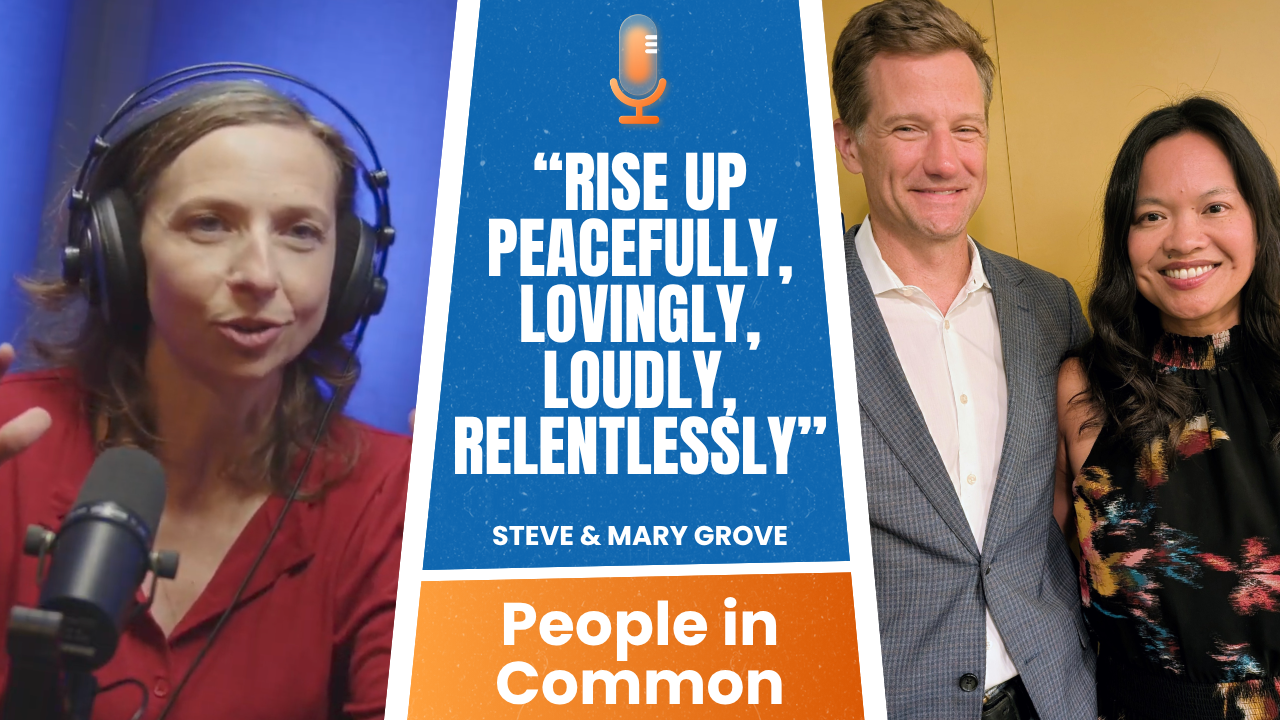
Mary and Steve Grove - Episode 18 People in Common Transcript Recorded July 17, 2026 JAMA ADAMS: In January 2026, Minnesotans showed us how to resist being occupied by your own federal government. Their answer was to do it lovingly, peacefully, relentlessly, as Mary Grove put it. Today we're talking-to a couple who were both personally and professionally involved in that story of 4,000 deportations by federal agents. And they are Steve Grove who runs the Minnesota Star Tribune, despite not having had 'publisher' on his bingo card, as he tells us. And Mary Grove, who left Silicon Valley to build a venture firm and a community in a place she chose very much on purpose. They help us understand the civic exceptionalism and the muscle memory that Minnesota had built in years prior that made the resistance work. And they're going to show us how to do it. Let's get into it. INTRO (static open) Welcome to People in Common. I'm Jama Adams. This is a podcast where we talk to leaders about connecting their personal stories to what's happening in this moment. What are we supposed to do? How do we translate values into action? How can we be People in Common? Jama (00:29) Welcome to People in Common. Steve Grove left Northfield, Minnesota for California, spent 12 years at Google and YouTube, came back to Minnesota as state government, and now runs the state's newspaper. His book is about reinvention, community, belonging. Mary Grove is a Californian and the daughter of immigrants who built something out of nothing. She now works across the capital stack and chose Minnesota to build her venture firm, her nonprofit, her family. Then in January, 2026, with federal agents in the streets and families afraid to leave their homes, everything they had built was tested. A community that chose to sing instead of surrender. Even in sub-zero temperatures, a resistance that worked. Today, they're going to help us understand what held, what we can learn from what Minnesota made possible. Welcome to my friends and amazing humans, Mary and Steve Grove. Welcome to People in Common. Mary Grove (01:37) Hi Jama, thanks for having us. Steve Grove (01:38) Thanks, Jama. Jama (01:41) You are awesome. I'm really excited for this. Right. We're going to start with belonging. Steve, your book is called How I Found Myself in the Midwest, A Memoir of Reinvention. And it's part of what you're theorizing is that choosing a place is different from belonging to a place. And I want to hear from both of you. But Steve first, where and how did you know that you really belonged? Steve Grove (02:13) Hmm. Well, I suppose people are what makes you feel like you belong or a place is just where you are. I don't think it happens overnight. I mean, one of the stories that tell them the book is, you know, leaving your home state and being gone for 20 years and coming back doesn't mean you just set it right back in. course you have to readjust and meet people and put down roots. And for Mary and I coming to Minnesota was a bet on the state and on middle of the country and on building a community here. But that took some time. And you know, the story that. I share our story that we share is, you know, sort of how you go about doing that. How do you make friends in your forties? how do you put that race in? Yeah. Yeah. Well, I think for men in particular, you know, there's, there's well-documented challenges of adult men finding friendships and deepening community. And I think that's a broader story America's facing. No matter where you live. So I think, you know, that's a piece of it. I think also one of the ways that I think. Jama (02:50) That was some of the best parts of the book. Some really good how-to's everybody. So get the book. Yeah. Steve Grove (03:09) we have felt like we've belonged has been investing in the local community. and I both worked at Google. We worked at companies that had these sort of focuses. And for us, really focusing on local has been really meaningful for me, first in state government, now in local news. Very different from working at Google and YouTube where Mike's putting the most to Mike. But really meaningful. so I think investing in a place and its people is how you feel like you belong. And it takes time. Jama (03:14) Hmm. Yeah, yeah. And Mary, same question. And I think that is, you ran Google for startups in 100 countries. What was the choice to come to Minnesota like? Talk about the community that you found there and that you're building. how does that relate to belonging? Mary Grove (04:00) I've always been such a big believer. You know, people ask a lot, where are you from or where's home? And truly, over the course of the last couple decades in particular, home I've really come to believe is the place you choose. It's the place you create. And I have so many different versions of that answer. One answer is San Diego, which is where I grew up. We moved there when I was about three, so that's really the hometown that I remember and lovingly claim. But the Bay Area where we met, Jama, you know, has such a Jama (04:13) Hmm. Mary Grove (04:30) special place in my heart. I went to college there. I started working at Google there where I ended up, you know, back and forth to the Bay Area for fourteen years, a total of twenty years. So that's home. Thailand feels like home in its own way. I call it my it's the homeland in a way. My parents both Jama (04:42) Hmm. Mary Grove (04:46) grew up there, immigrated from there, and so a strong sense of culture and roots. And then now of course, Minnesota, we're into the better part of a decade, eight years in, and it's been a journey. It's been highs and lows. I think more than anything that more than I could claim belonging, it's I would almost describe it as a feeling of aspiration. It's the hope for to belong, but also the second thread is the contribution of what Jama (04:58) Yeah. Hmm. Hmm. Mary Grove (05:15) what can I bring or what can I what can I knit together to help build the sense of community and the actual community fabric too. So I think it's aspirational all the way. And I'm I think the story will continue to be written. But what drew me to this chapter of our lives was really a combination of personal and professional excitement and that aspiration. I think on the professional side Jama (05:23) Hmm. Mary Grove (05:39) in my last you know six or seven years at Google, I had been building out a lot of that investing infrastructure, working with startups, right? The the Google for Startups work that you alluded to and thought about democratization of access to capital has been a big theme for how do we look at markets that are overlooked within the current capital stack. That's both Jama (05:53) Hmm. Mm-hmm. Mary Grove (06:00) From an emerging markets perspective, but within the US, these very emerging markets across the country, including the Twin Cities, right? Including Nashville, Boulder, Denver, Austin, there's a whole list of really exciting economies. And so that's I'm your child in a way, right? For completely immersed and grew up professionally in Silicon Valley in that world. And then to make a volitional decision, I think to Jama (06:06) Hmm. Are you sure there's anything outside of Silicon Valley? You're totally sure? Yeah. Mary Grove (06:28) to be in the bit of the underdog seat has been really rewarding. And then on the personal note, you know, as I shared, I'm from an immigrant family. And so I have a huge family footprint in Thailand. But in the US, we're very, very close, but there are very few of us. On Steve's side, we have, you know, 50, 60 plus people in the Midwest. I think that's probably much higher, right? But the idea of raising our children and our family amongst that was really compelling. So it was a volitional choice for sure. Jama (06:32) Huh. Hmm. Mary Grove (06:57) And it's been a journey of growth. Jama (06:57) Yeah. Yeah, oh my gosh, there's so many cool threads to pull on here. I guess I want to hear a little bit more about what that building has been like for both of you. especially, Mary, let's talk about the, I've heard you say before, the overlooked, right? Like overlooked markets, overlooked entrepreneurs. And that underdog feeling, is such a, I mean, everybody can relate to that, right? And we're all, think this moment is really all about that. And obviously, Minnesota has a special, we'll get to why Minnesota kind of was punching above its weight, if you will. But talk a little bit more about exactly what you're, so Bread and Butter Ventures is the name of your venture firm. And we're going to put links to the, you know, to how people can learn more and be part of it. talk about what it's meant to make that choice, to reject the Silicon Valley self-indulgence and self, let's just call it that, and really go deep on overlooked underdogs. Mary Grove (08:09) Yes, well I think it, I think it's both, and so the Silicon Valley chapter and all of the lessons that we can learn from Silicon Valley and its ecosystem, its density, the speed, the pace, the aspirational big picture vision, that's also thing things that we embrace and I think are fundamental to building venture-backed large, you know, huge companies that can have tremendous impact. I think the benefits of places like Minnesota and these overlooked markets is we talk a lot at bread and butter. So our Jama (08:27) Yeah. Mary Grove (08:39) Our thesis is we want to invest in early stage companies, seed stage companies nationally, so coast to coast, and but we want to go deep and leverage our backyard. We lovingly call it the Minnesota Home Field Advantage, right? Means that Minnesota is at the epicenter of the largest density of Fortune 500 companies per capita in the nation, in particular. Jama (08:45) Mm. I learned that from Steve's book. Yeah. Mary Grove (09:01) Right? Super, super strong, particularly in healthcare, in the food system, and just large enterprises generally. But our thesis is let's leverage that backbone by partnering with twenty huge enterprises, you know, Ecolab, Cargill, General Mills, Hormel, Mayo Clinic, 3M, Target, Securian, household names that you know, but did you know they're all headquartered here in these trillion dollar global economies. based out of our backyard. So our thesis is let's leverage Minnesota. All that's to say, I don't, you know, we're our ambition isn't to replicate and build the next Silicon Valley, it's to build the next Minnesota, to build Minnesota specifically and to invest in Jama (09:28) Hmm. Mary Grove (09:42) want to be you know a tier one world class venture capital firm based in the Midwest, based in Minnesota, not be in spite of our location, but precisely because of that location. And so investing in you know these these heartland infrastructure companies that are based everywhere. So it's really been that through line of how do we help companies scale? How do we help them raise capital from coast to coast after we invest? How do we help them enter markets globally? So but that through line, the aha for me is what's right in your backyard and what might you Jama (10:08) Yeah. haha Mary Grove (10:14) do differently. My our innovation of bread and butter, I believe, has been nobody's leveraging that enterprise backbone that I just described at scale from a venture perspective. And these titans of industry, of course, they're hungry to work with emerging tech in their verticals, but nobody's built that connective tissue. And that's the opportunity set of a lifetime. So I do feel like we are operating an underdog market, yes, and I would bet on that all day long. Jama (10:23) Hmm. Yeah, well, and so relatable, I think, for everybody listening, whether or not you are a venture capital expert like Mary Grove, we can all relate to that. And that's what this show is all about is how do we invest and be part of where we can start, right? Not trying to be something else or do it exactly the same way, but there are so many lessons. that you can take, right? Taking the best of the aspirational. I love that, right? And the best of the places that you've been and worked and applying it in your own backyard and making a very, you guys, this book is all about making that choice and making it over and over again to each other, with each other, with this new community, right? Steve, talk about what you've been building and... Think in the context of that community and belonging and your journey. Steve Grove (11:43) Yeah, well, I have three years into a job I never thought I'd have, which is the publisher of a newspaper, Minnesota Star Tribune, and I'm honored to be doing it. You think so? Jama (11:50) don't know, we could have predicted that. Come on, when I met you, that wasn't totally out of the question. You were a journalist and... Fair. Steve Grove (11:55) Well, I've long liked media, but spent most of my career in that. I really didn't have being a publisher on my dance card, if you will, but I really enjoyed it. It's a really essential institution to our state. So the structure which I run today is an extraordinary organization. It's been around for 159 years. It's kind of part of the fabric of Minnesota. And as I think most people kind of intuitively understand, local news is really an essential part of communities. information ecosystem and democracy, frankly. When you have strong, dense local news networks, you get better outcomes. More people vote, more people show up, more people donate to charity. All of these kind of indicators of civic strength are really predicated on having local news organizations strong. Jama (12:27) Mm-hmm. And is that it's. Yeah, just to double click. that so that's it makes intuitive sense, but it's because people are more informed, but there's probably more to it. Like, why is that? What's that and is it causal? You know, like. Steve Grove (12:54) Well, research will show you. Yeah. The research will show you that it is. mean, just in terms of the pure density of the number of local news reporters in the market, I think you have more information about what's happening. You understand issues more deeply. Take that information and do with it what you will. But when you have a shared common sense of facts and reality, you know, shocker, you get a stronger sense of community togetherness and ability to make the community better, right? Jama (13:05) Hmm. Whew. Steve Grove (13:20) You also get more accountability. Northwestern just recently did a study that said that when you have strong local news in a community, you gain about 85 bucks per year in taxpayer savings based purely just on government accountability that the investigative journalism and strong reporting can provide. And that's a lot of money. And so it's important. We all know that. Well, yeah, and it's declining, right? So in the last two decades, we've seen about 75 % of local journalism. Jama (13:22) Yeah. Yeah. Yeah. Especially right now. People could use it. Yep. Yeah. Steve Grove (13:50) in our country vanished, right? People have left the profession and the market faces huge headwinds. The reason that I took this job is because, you know, the company that I used to work for and many others had changed the game significantly and local news organizations hadn't figured out yet and haven't, I would say, how to really do robust and broad reporting with a business model that works. So that's the journey that we're on. We're trying a lot of new things on that front. But it's really meaningful. And I guess, again, for Mary and I, betting on Minnesota, betting on place. You look around, what are the institutions in your state that are the most important for a place to be healthy? you know, local news is one of them. So it's been a really extraordinary journey, a huge transformational effort. But we are lucky in Minnesota to have a state where people participate civically. They show up. We have the highest voter participation of any state in the country. And people do read the news. So we face the same headwinds as everybody else, but we've got, I think, a market here to tap into and... As we become a modern digital media company and no longer a newspaper, that's the trick is how do get that right, create a business model that works and provide really that essential infrastructure that is deciding needs to be successful. Jama (14:59) Mm-hmm. It's well and let's kind of dig into sort of what happened. I newspapers were I became a Strib subscriber during the crisis. Of course, I mean, but I think but I think especially because of the crisis that hit Minnesota, you know, a once in a generation story. And you're right at the helm, right? As this is unfolding, Steve, you know, Steve Grove (15:10) Thank you. Yeah. Yeah. Jama (15:27) Walk me back to January of this year, beginning of the ICE raids, Operation Metro Surge. You know, it's the biggest story. You guys personally got pulled into this a little bit. Just walk me through sort of that whole experience, what that was like for you guys personally. And then I'd love to talk about sort of how all of these lessons and the sort of Minnesota-ness. really prepared Minnesota for responding to it. Steve Grove (15:58) Yeah, well, ICE has been in a lot of communities across the country, but I think that the world saw in January and February of this year in no place where there was more backlash, resistance or ability to document what was taking place than in Minnesota. think, from your perspective, there's a of... Yeah, exactly. mean, Minnesota is... The metro area is not that huge. And so there's the ability for our reporters and many others to document what was taking place in our streets. Jama (16:12) Hmm, really critical piece, right, is what you were talking about. Hmm. Steve Grove (16:25) I would call it the most documented crisis in American history right here in Minnesota because of the number of people out there with cell phone cameras. You couldn't have a single thing happen without folks being there. Compared to, for example, in Los Angeles, so much more sprawl and spread out. Alot of ICE activity, but hard to capture it from a journalistic standpoint. But we had that ability to capture it as did many of the citizens in our state who were covering it. And then you had a populace that was kind of…just wasn't going to have it. Jama (16:29) Wow. Steve Grove (16:55) And, you know, from five years earlier, when you know, George Floyd was murdered and there was a lot of mobilization and you know, the riots that followed that tragic event, you know, were considerable. “There's a bit of a sort of muscle memory there that I think Minnesotans - that took place. And then going back to the things I talked about a moment ago, this kind of civic fiber, the sense of community, this sort of civic exceptionalism, I think that exists in Minnesota.” Steve Grove (17:18) “All those factors, I think, led to what you saw and everyone saw around the world, which is just massive uprisings, lots of documentation, and then some really tragic events that I think mobilized far more people.” You know, from our perspective at the Star Tribune, you know, our job is to document that, to bear witness. And when you can bear witness and let the rest of the world know what's happening, it's an incredibly powerful tool, frankly, you know, to hold people accountable. And I think that coverage is really critical. You're right to say Mary and I ourselves got kind of drug into this in an odd way, which is Steve Grove (17:48) Maybe an interesting warning sign for where AI is taking us, but essentially some online vigilantes used Twitter's unmask feature, where they unmask people to try to figure out who they are. And they tried to unmask the ICE shooter because he was wearing a mask when he shot Renee Good. And the face that was revealed and created by AI matched the face of another person named Steve Grove, who lives in Missouri. They then used that information to claim that I was the ICE shooter. So for a couple of days, we were a little concerned that people thought that I had somehow killed Renee Good, which is of course preposterous. But you know how, you know, web communities can work. And so we had to navigate that, but you know, we were fine in the end. isn't about me, but it's a reminder of just how important quality information is in these moments and why the Strib’s work, I think was essential to how the world and certainly Minnesota responded. And, you know, we got about - I think all 50 states, from all 50 states, subscribers like yourselves, you probably weren't really paying attention to the Star Tribune to being somebody subscribing. So yeah, people were paying attention. I don't know, what would you say, Mary, is that a fair summary? Jama (18:49) All right. Yeah, we hit the streets. We spread the word. Heck yeah. It's... Mary Grove (18:58) You know, I can address it. I mean it's super fair summary. I can kinda speak to it from some of the ground game activity that we saw. And I think one of the things about Minnesota that and moving here and being new here, I've had this, you know, deep desire to really understand and then be a part of the in the entirety of the capital stack from end to end. And we're fortunate in Minnesota we have mix so many different types of institutions. And so that ranges from you have that large Fortune 500 base that I talked about earlier. You have quite a few large foundations, nonprofit sector that's thriving. Steve talked about the generosity of Minnesotans among the heights. Jama (19:34) many of which you are on the board and supporting just giving you a shout out for being a huge part of that. Mary Grove (19:38) Thank you. No, it's been it's been my desire actually was how do I get involved with things that I might not naturally intersect in my daily work and try to get some of those threads together. So yes, I'm really lucky to get to serve on two foundation boards here. One is the Minneapolis Foundation, our large community foundation that does so much work in Minneapolis, in Minnesota and beyond, frankly, around education, re racial justice, you know, climate justice, a whole range of Jama (19:45) Hmm. Mary Grove (20:05) really important you know community work happening. And then I serve on the board of the Bush Foundation, which is a large private foundation based here doing phenomenal work in Minnesota, North and South Dakota, and the 23 Native nations that share that geography. But just examples of some of the institutions. So when Metro Surge was really you know in full swing, we saw our institutions able to mobilize so quickly and be that unifying force to bring everyone along. And so a couple quick examples, the Minneapolis Foundation, you know, immediately mobilized and launched something called the Economic Response Fund, which you know, then mobilize several layers beneath. So my firm, Bread and Butter, for example, helped co-host and bring together an event for the venture and startup ecosystem. Can you give $100, $500, $1,000? And corporations give a million dollars. Everybody pools together this immediate action. So four million dollars came together into a central pool to give relief grants of, you know, twenty five hundred dollars to ten ten thousand dollars to restaurants, you know, businesses on the front lines that were affected. So you saw that kind of Jama (20:54) Hmm. Wow. Mary Grove (21:14) infrastructure quickly mobilized by institutions. And then the other side of my heart, you know, as a mom, as a parent, part of these moms groups, these parents groups, the parents who are not going to let their schools be harmed, you know, without standing up. And so I was so moved in that moment and so proud. I am always proud, but “especially proud to be a Minnesotan because I didn't know a single person, Jama, who wasn't helping to the max of their ability whether that's driving kids to and from school, you know, food shelter delivery, last mile delivery.“ We were volunteering weekly at this amazing organization called Casa Maria that you know typically they offer food pantry relief to about 50 families per week during Metro surge they scaled up to 500 families per week they were serving last mile delivery to the door so it was individuals buying shopping driving Jama (21:42) Ugh. Mary Grove (22:09) And just to see the love and the compassion, but you know, on a personal note is very jarring, right? I am a US citizen, I was born in the US, but to have that conversation with my friends, other friends who are also from, who are people of color, and have that conversation about, okay, do we carry our passports, do we carry a copy, do we carry the real thing? How do we talk to our nine-year-old children about their very valid fears that, you know, mommy, you look like an immigrant. While I realize this isn't about me personally, just “That threat of fear permeating the community, it really gave Minnesota and I think the community an opportunity to rise up peacefully, lovingly, loudly, relentlessly, and that just gives me hope for a blueprint.“ that hopefully we'll not have to use as a playbook too often. But you know, we learned a lot. Jama (22:49) Hmm. You It's, from the outside, this is why I was so looking forward to talking to you two specifically about this. lovingly, peacefully, and what did you say? Fierce, resist, all of those adjectives. Relentlessly, that's right. That's definitely what it felt like from the outside. You know, we're watching kind of the huge protests in sub-zero temperatures. We're watching. Mary Grove (23:15) Relentlessly, fiercely, yeah. Jama (23:30) You know, 300 people show up in a neighborhood to sing. The singing resistance was, I'll be honest, maybe top of my list. I, every time I watched the video, I would just cry. Right? Cause that we will not be moved, right? This little light of mine and we shall overcome and just, you know, the response. But like you said, it was peaceful. It was loving, but it was relentless and ultimately was successful. Right? I mean, if you can call anything that happened. at that time successful, right? The resistance worked in the sense that they left, right, finally, right? Talk a little bit more. You guys have been so, you know, what was it like, know, Steve, you sent us one of the most impactful emails was when you were sharing your brother and your sister who were part of that effort too, right? And I'm sure they were not the only, you talked about all of the people who were delivering groceries when. families couldn't leave their houses. Your brother at Hiawatha organizing because half of the kids weren't at school because they couldn't, because they were scared to be part of this. mean, you were writing about that so beautifully and on the phone with your brother and sister who I'm sure were falling apart. The personal and the professional, and you guys have blended these so beautifully. guess, can you both talk about... what that was like in the moment, trying to do and balance all of that. Steve Grove (25:04) Well, you know, I think in Minnesota, for unfortunate reasons, last five or six years, we've had a lot of crisis in our state. mean, of course, Operation Med-O-Servo, we're talking about here. But you know, the year before that, we lost, you know, the speaker of our house in a violent murder, along with her husband, in the of the night, which was a very jarring and tragic circumstance that completely changed the complexion of our state. had... Jama (25:13) That muscle memory you talked about. Yeah. Yeah. Steve Grove (25:30) horrific school shooting last fall at a school just a few blocks from our home that the sheriff recently went up hold surprise recovering. I mean, these are heavy topics. And of course, you go back to George Floyd's murder here and Minnesota has, I mean, probably moved here. It's just a great place to live. And that has remained the case. I mean, it's it's about it's punch above its weight in so many places, which is a lot of what I like to share in the newsletter you reference the view from Minnesota where we're talking about what's happening here. But I guess I'd say that all to say that we have had our share of crisis these last five or six years. And I think what Jama (25:53) Yeah. Steve Grove (26:00) Mary and I realized and curious why you would reflect on this Mary, like crisis can also just galvanize and focus you and when you care about a place, know, when a crisis hits, you're just looking for ways to take action and whether they're small or big or in whatever direction. I do think crisis has a way of bringing people together. And I feel like Minnesota, despite the hits that we took from this and, you know, the tragic loss of almost 4,000 people who've been deported out of that. Jama (26:07) Hmm. Hmm. Hmm. Steve Grove (26:25) event in which, by the way, the service turned to get the names of every single one of them so we can hold the government accountable. I do think as a state that did bring people together in unique way. I think no one would ever want such terror to land in their community. And “Certainly to feel occupied by your own federal government is not a great place to feel, regardless of your feelings of immigration.“ That the execution, I think, I'll agree was challenged. But I think it did galvanize Minnesota uniquely. Jama (26:31) Awesome. Yeah. Steve Grove (26:53) You know, it would be my answer. And I think I hope it makes it stronger. But in the meantime, we took an economic hit from it. And I would say the state's still processing and reeling from it on a whole host of fronts, not least of which we have far fewer workers in our state now. And the economy is kind of rebounding. And we've seen that in the data. So, I don't know, Mary, how would you classify the crisis here? Jama (27:01) Yeah. Mary Grove (27:17) I think it's an opportunity, right? I think certainly proud of how you look back on it and think, okay, really proud of how the community instinctively reacted. That shows, you know, care and who you are, and that's kind of an emergency response, a crisis. But now it's about and by the way, you know, it's not that is over, right? Even just yesterday I had somebody told me to ask me for, you know, do you have recommendations from an immigration lawyer for somebody who can't afford it? They're Jama (27:26) Hmm. Yeah. Mary Grove (27:43) Uncle was detained, this is being deported. And so, you know, we were far from the, I think both the immediate we're still in feeling aftermath, feeling crisis. The infrastructure, the economic infrastructure too, it would take months or years to build and heal. And I think so. Where my mind shifts is okay, preparedness and investing in future infrastructure to be ready and just to also it's opened up. Jama (27:54) Yeah. Hmm. Mary Grove (28:11) And this is where I think the kind of start of innovation that comes in too. But it's these crises expose vulnerabilities right in the overall systems. And then what are some solutions that we could build for them? And so even think about even within our portfolio, and these weren't built for metro surge, right? But thinking about how we can continue to invest, for example, one of the Jama (28:14) Hmm. Mary Grove (28:33) Portfolio company based in Minnesota. It's called River Health. They've scaled nationally to be providing their mission is the 75 million Americans who are hourly wage workers or shift workers who are not eligible for Medicaid or and do not have, you know, employer-sponsored commercial insurance. What about that huge gap? Jama (28:52) Wow, 75 million. Wow. Mary Grove (28:55) 75 million Americans. And so what what River Health has done is built this comprehensive health plan, insurance plan, coupled with virtual care that's high quality provided in-house to really address this whole category of workers. But I think about these gaps of who gets harmed the most in these crises initially, and then proactively, those are huge opportunities for innovation in the capital markets too. So it's not just Jama (29:19) Hmm. God bless you. You're like, wait, people are home, unsafe. They don't have healthcare. They don't have food. And Mary Grove is like, guys, now we're going to build the thing that we needed then, and we're going to be ready. Mary Grove (29:32) I think, you know, well credit credit belongs to the innovators like Kobe Omoa from River Health and the teams, but it's how do we then realize, okay, let's double down on these gaps or in the food system, right? There's a lot of opportunity for that. And I think we realize just like with COVID, right? We realize the vulnerability of our supply chain in medical equipment globally, right? A lot of redundancy built in there now. Jama (29:37) Yes. Bless you. Yeah. rights. Mary Grove (29:54) of how we think about suppliers and where we source from and where we manufacture and how we drop ship things. So I think the same applies now to thinking about this. So I think it's both a we feel the gravity of it and also the hopefulness of okay, great. That was good that was a good reflexive response. And we can also really get proactive about having this conversation nationally too. Jama (30:17) Right, having the conversation and pulling those threads together as you've said, right? let's find those innovators like Kobe, right? Let's find those folks who aren't kind of getting, automatically getting those meetings on Sand Hill Road in Silicon Valley. Let's find those founders. Let's work the venture capital arm. But also you're going to wear your foundation hat and you're going to make sure that the foundation world is understanding the Kobes of the world and how that resilience, right? Like what kinds of things and incubators and accelerators you've, we haven't even talked about Silicon North Stars, which is like earlier, earlier in that pipeline, finding those future entrepreneurs and those, you know, talk a little bit about that sort of tri-sector approach and both of you, because obviously, you know, Steve, we haven't even talked about your response on COVID, but from the government, from the private sector, from the nonprofit sector, how do you weave all of that together? And specifically for Minnesota's case, right? You've now seen these crises and here's the resilience. Mary Grove (31:24) But one of the things I get really excited about is exactly that of a lot of these pools of capital today they don't interoperate or talk with each other. And if you think about the flow of that, so you have these institutions, these foundations, for example, all over the country. pension funds, college endowments, university endowments. Let's just talk about foundations for a second. If you have an endowment model, that endowment is invested in the market. And a subset of that portfolio is in the private market. The private market includes venture capital firms, for example. And one of the shifts we've started to see nationally is this concept of impact investing. It's a loaded term means a lot of things to different people. The concept of carving out some of that endowment capital to invest specifically in things that make a direct impact as you, the organization, define it. And so in Minnesota, I think we have some of the foundations who are at the forefront of thinking about this St. Paul, Minnesota Foundation, Bush Foundation. We're really fortunate to have a lot of foundations. But the idea is, could these endowments, could these foundations invest some of their endowment into funds that are either geographically diverse, are led by diverse and female fund managers, are investing in diverse and fem and female-led companies, are investing in topics like healthcare, like climate, like economic mobility, right? That move the needle. And so you have the flow of capital coming from the institutional level into the fund level, into the company level. They have big outcomes, they recycle back into those LPs, the limited partners, we invested again. And so I think that's it was such an aha moment that I feel like national conversation is igniting around that now. And so just one example. But Minnesota's a great test case for that because we have all those things, right? And so that's the question I would pose to any allocator or investor tuning in today, right, is what role can you play in genuinely moving that needle in the capital stack by thinking, you know, what's in the backyard as well or what's that next infrastructure play that you want to invest in. Jama (33:05) again. Mmm. Mm-hmm. Mm-hmm. And Steve, as you have lived in many of these sectors and are sort of doing it from a different perspective, you've written that Minnesota is maybe writing this playbook in real time. You've talked in your newsletter, and you can check this one out, that in the February newsletter, it's all about, there's a few pieces, the distributed leadership, peaceful protest. Citizen documentation and local news, we've talked about already. Mary's talking about philanthropy and the mutual aid, which, you know, that's literally delivering groceries to doorsteps, kind of the more mutual version of that. What does that playbook look like and how can people be part of it? Steve Grove (34:14) Yeah, it's funny because to write it down in a newsletter is an interesting exercise. I don't know that people in the streets had a playbook in their back pocket either, right? Some of this is just instinctual and responsive and I think... Jama (34:18) haha Instinctual, think that's such an interesting word. Yeah. And it was care. Steve Grove (34:27) Yeah, what ties it together, I think, is a people, a sense of identity and knowing what your place is about, what you stand for. And then depending on your role or your lane in the community, you take that identity and what you stand for and you apply it to what tools you have around you. So to Mary's points on whether that's your adventure and foundations or for me in government or media, um, you use the tools around you to live your truth at a moment when you're needing most. And I think. Jama (34:32) Hmm. Yeah. Steve Grove (34:56) For me, and I think the same is true for Mary, for us both having kind of spent the bulk of our careers at a big tech company in the Valley and then kind of hitting a jackpot moving here to Minnesota and having this moment of reinvention, we've gotten to put on a different pair of glasses. And it's pretty refreshing. think most people will resonate with that. Every one of your listeners has had moments of reinvention. And I've just become a big proponent of it that you put on a different, you get in a different role with the same values and you can do different things. And you also bring a superpower, which is fresh eyes to it. Jama (35:08) Hmm. Steve Grove (35:24) That's been true for us at the Strib as we've tried to reinvent ourselves, not just me, but our whole leadership team has come from different parts of the economy and community. They're not all just local news leaders. Not that there's anything wrong with that background, but we're trying to bring in fresh perspectives. And the same was true in government. A lot of times when you're new to something and you bring a skillset that might be somewhat different than your colleagues or your new partners, people give you bit more of a lane to innovate because they just know you're different. And so I'm a big fan of, you know, when it's right. Jama (35:49) Hmm. Steve Grove (35:53) taking a shift and trying something new. And for anybody listening here who would consider doing something in government or the nonprofit space, I really encourage people to find a way in. I think our founders intended our country to be the kind of place where you go into government for a bit and you come back out and you bring your experiences to different parts of society. I think that's really important. And it's important right now more than ever. And I think most importantly, on the local level. I mean, that's been a big lesson for us is just. You move to a place and you invest in the community and the impact is more tangible. It's more real. Frankly, you can change more than you can in federal national contexts. It wasn't to say that we didn't feel like living in a valley wasn't also exhilarating and certainly working at a company like Google and YouTube was a huge honor. And to get to be part of building that was great. I feel more meaning in my work here than I did there because it's right in front of me. And I feel like it can actually move things more. And I also think ultimately it's going to lead up to something, you know, Jama (36:26) Hmm. Yeah. Steve Grove (36:48) bigger for our, for our state. And if we're to reinvent our country, I just don't think it's going to happen from Washington, DC, right? I think it's going to happen from, uh, communities like ours across the country. And so that's a fun thing to get to do. And I encourage anybody in the podcast thinking about it to, whatever makes sense for you, find a lane where you can live that out. And I bet you find it rewarding. We certainly have. Jama (37:08) Yeah, yeah. And let's get specific because I think you write about in the book and obviously you two are involved in very, very concretely is, you know, what are a few examples of those things for each of you? Steve, I'll ask you to go first because I'm sure they're top of mind. What are the things that you've been involved in that are just, you talk about how fun it is. I think in your book you say and getting involved in local government is fun. No, really? Steve Grove (37:35) Yeah, yeah. Jama (37:36) I was like, that's so Steve. love this. What, you know, what's the fun? Like what are the kinds of things? And again, like you said, it's different for everybody, but you know, what are examples? Steve Grove (37:47) Well, I think in part, it's just fun to get to meet new people with different backgrounds and experiences. And I really enjoy just meeting what you might call government bureaucrats, but who are actually like wonderfully innovative, creative, thoughtful people who are in it for the right reasons. I just enjoyed that and I got to learn from my new colleagues. I also think it's fun to rebuild things. mean, you know, we had an unemployment insurance system in our state, which was very well run before I arrived, certainly. And then the pandemic hits and your caseload, you know, Jama (38:06) Hmm. Steve Grove (38:14) is exponentially larger and you have to adapt that system to a new circumstance and trying to figure out how you do that, whether it's getting your tech onto remote servers or translating it into languages or figuring out new ways to develop shifts so that your system can understand and take in the number of applications that are flooding in as more than 400,000 jobs are dropped from the economy in a matter of about a week in April of 2020. was, I'm not saying that was fun in the sense that we were glad it was happening. But boy, do you feel a sense of meaning when you get to work in crisis moments like that. And I think, I think it's fun to solve new problems with new people, you know? And I think the same is true at the Strib. I mean, we're trying to reinvent 159 year old institution. Everyone agrees it needs reinvention, but the details matter. And like figuring out the details and the plan and working it and the cultural pieces of creating a space where failure is actually okay. Jama (38:44) Hmm. Hmm. Steve Grove (39:07) know, news organizations and government bodies aren't necessarily known for that kind of launch and iterate mentality that Mary and her startups just kind of live with. Like, these are storied institutions that are a bit more reserved. And so it's fun to try to work with Google to change that culture. And I think it's also essential. so, I don't know. Hard work is worth doing. And I've enjoyed the chance to kind of bring into the lens of some of these roles. Jama (39:17) Hmm. Yeah, yeah. Mary Grove (39:32) I think I would I would just say on that note as the passenger seat viewer, you know, of seeing Steve shift from tech and private sector into more public sector and civic, which I think we always all ever everyone who knows and loves him knows that those are two just deeply intertwined threads for him. But I've just been really so moved by both for his journey and so many people I've been able to meet along the way through his work and some of our work together. It's just the true the service in public service, I would just underscore, you know, a thousand times. And I think in our in the current era of extreme polarization and tension and a lot of people are in lot of pain, you know, it's it's so easy to feel jaded and to feel suspicious and to feel like I'm just going to detach from everything government related that someone and I'm not going to. I would never run, I'm not going to vote, I don't want to go to an election. Jama (40:03) Hmm. Hmm. Hmm. Mary Grove (40:30) I don't want to you know donate, a contribute, campaign for somebody. And I the perspective I would share is just the true element of service of these incredibly talented people who have just true hearts of service. And that the work is hard. It's really so admirable, right? And they've come from impressive backgrounds and they've in many cases given up more comfortable circumstances, right, to be able to Jama (40:43) Hmm. Hmm. Mary Grove (40:55) serve in this way. And so I just have such a deep respect for that. And I think now is the time more than ever, whether that's a small example as I went to our local neighborhood caucus for the first time this year because it felt more important than ever writing to see well who what is the process and is it representative and is there a different view that I could voice there maybe. But I would just say yes if you're if you're thinking about it. But also if you're thinking about a Jama (41:08) Hmm. Mary Grove (41:23) small way of getting involved, like learning more about a candidate and getting involved, door knocking on their behalf or just, you know, we are really only as strong as our system and we can really be a part of that. Jama (41:30) Woo woo! You Yeah, and on the local level. Okay, and last thing, just each of you, word, phrase, paragraph, just something you want to leave the People in Common audience. These are, you know, we are busy, all of us and all of us in People in Common are just are busy, caring, but very busy people. You know, what is one thing that people can do this week? You know, just something very concrete that is A lesson you take from Minnesota showed us how earlier this year, but the ongoing work that you both are involved in, what's one concrete thing people can do? Steve Grove (42:15) I would say Subscribe to a local news organization, wherever you are. Or donate to one. I know that's simple. It might sound self-serving. It doesn't have to be the Strib, but Local news costs money. A free press comes at a real cost. And so you'd be surprised by how much of a difference that makes. And given that Americans don't think about paying for news these days, I would just encourage anybody listening to consider subscribing to local news organization or donating or doing whatever you can to support. Jama (42:24) Hahaha! Yeah. Yeah, great one. Okay. Mary Grove (42:44) I would say maybe try to find one organization, nonprofit or community organization in your local community that you know nothing about. Maybe that's, you know, ask a couple friends and just try to learn more about one of them and maybe make a make a contribution if that makes sense, maybe volunteer. But one of the things that I learned through our crisis earlier this year in Minnesota was, wow. Jama (42:58) Hmm. Mary Grove (43:07) There are so many organizations pioneering unbelievable models that again could be templates that I don't know about. And I learned about them so quickly because we were also urgently sharing information. So that's maybe, you know, phone a friend or a couple friends and just what's one or two elements on your radar, you know, Jama, that are interesting that I might know or follow or maybe give to in my annual giving. So that's maybe one small action. Jama (43:08) Heh. Hmm. That's a great idea. I think, you know, and obviously if everybody kind of has their top three in there, I love this. Okay. My friends, my dear friends, this was as wonderful as I hoped it would be. Thank you both so much for these lessons and just for exploring this. I'm so grateful. Steve Grove (43:49) Thanks for having us, Jama. Mary Grove (43:49) Thanks for your amazing work and thanks for having us. So good to see you. Jama (43:52) Yes Steve Grove (43:52) See ya, Jama (43:53) always. Steve Grove (43:53) bye. Jama (43:54) Bye guys.